
Well Pump Installation & Repair Near Me
Starting price: Call for pricing
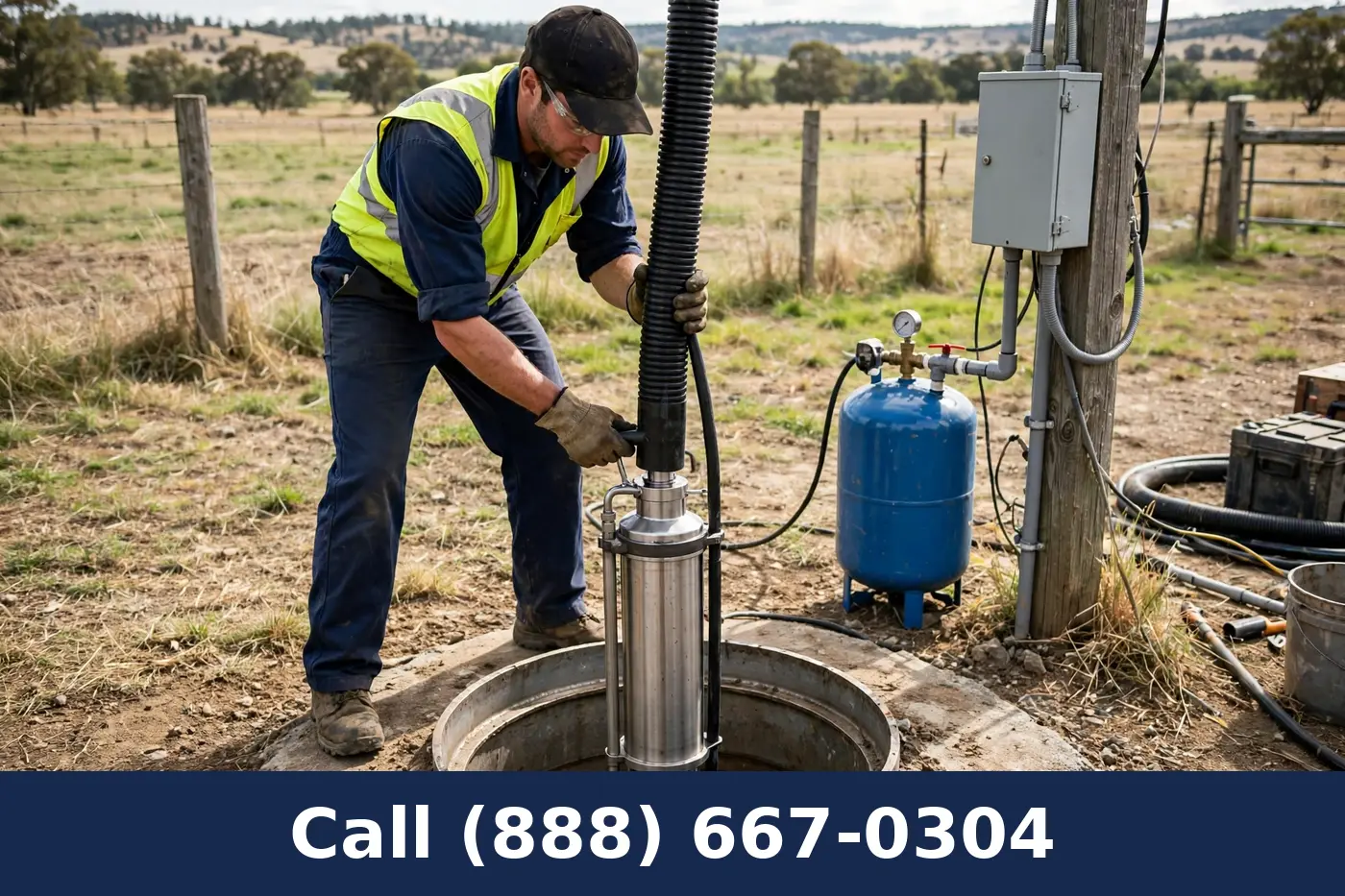
The well pump is the heart of a private water system, lifting groundwater to the surface and working with the pressure tank to deliver steady flow at every tap. Submersible pumps sit deep in the well and push water up, while jet pumps sit above ground and pull from shallower wells, and each type has its own failure patterns. Plumber Modesto Pros installs new pumps sized to the well's yield and repairs failing ones across the Modesto area, from pressure switch swaps to full pump replacements.
How does a residential well pump system work?
A private well system has three partners. The pump moves the water, the pressure tank stores it under pressure, and the pressure switch tells the pump when to run. The pump lifts water from the well into the pressure tank, which holds a cushion of compressed air above the water.
That air cushion pushes water to the taps at steady pressure while the pump rests. When the pressure falls to the switch's cut-in setting, the pump starts and rebuilds it. Most home systems cycle between roughly forty and sixty pounds per square inch, though the exact settings follow the equipment's design.
A check valve keeps the pressurized water from draining back down the well between cycles. When every part does its job, the homeowner simply turns a tap and gets consistent flow without thinking about the machinery.
What is the difference between submersible and jet pumps?
A submersible pump hangs deep inside the well casing, below the water level, and pushes water upward through the drop pipe to the surface. Because it pushes rather than pulls, it handles deep wells efficiently and runs quietly far below ground, which is why it dominates modern residential installations. A jet pump sits above ground, usually in a garage, well house, or basement, and uses suction with a venturi jet to draw water up from the well.
Jet pumps suit shallower wells and are easier to reach for service, but they need priming, run louder, and lose efficiency as depth increases. Well depth and water level decide which type fits: deep valley wells around Modesto almost always call for submersible equipment. Each type fails differently, so correct diagnosis starts with knowing which system is installed.
What are the signs a well pump is failing?
Fluctuating or steadily declining water pressure is the most common early symptom, as a weakening pump moves less water per cycle. Faucets that sputter or spit air point to air entering the system, which can mean a falling water level, a suction leak, or a failing pump. A pump that runs constantly without reaching shut-off pressure may be undersized for demand, fighting a leak, or losing its battle with a worn impeller.
Rapid on-off cycling, called short cycling, is the most destructive symptom: each start draws several times the normal current and wears the motor quickly. Rising electric bills with no other explanation sometimes trace back to a pump working far harder than it should. Any of these signs deserves a professional look before the pump fails completely and the house loses water.
Why is short cycling so damaging?
Short cycling means the pump starts and stops every minute or two. A healthy system runs for several minutes per cycle instead. A waterlogged tank with a failed internal bladder has lost its air cushion, so pressure collapses the moment the pump stops and the switch calls for another start.
Each of those starts slams the motor with high inrush current and mechanical stress. A pump built for a decade or more of normal cycling can burn out in months. The fix is often a tank replacement or air-charge correction rather than a new pump, which is why diagnosis matters.
A technician tests the tank by checking its air charge and listening to how it sounds when tapped. A healthy tank rings hollow at the top and dull at the bottom. Catching short cycling early saves the pump and replaces only the part that actually failed.
How does a pump installation visit work?
The visit starts with the well's vital statistics: total depth, water level, casing diameter, and the yield figure from the well's test records when available. That data sizes the pump correctly, because an oversized pump in a modest well causes its own problems and an undersized one never keeps up. The old pump is pulled by lifting the drop pipe section by section, with the wiring carefully disconnected and inspected.
The new pump goes down on new drop pipe with a new check valve, properly spliced waterproof wire connections, and a torque arrestor where needed. At the surface, the pressure switch is set to the correct cut-in and cut-out pressures and the tank's air charge is adjusted to match. The system is then run through full cycles while the technician watches pressure, flow, and cycling behavior to confirm everything operates as designed.
What common repairs keep a pump running without full replacement?
Pressure switches are frequent culprits and straightforward to replace, since their electrical contacts wear and their sensing tubes clog over time. Control boxes for larger submersible pumps contain capacitors and relays that fail with age and can be swapped without pulling the pump. Check valves that leak let the system drain back between cycles, causing the pump to restart constantly, and replacing the valve solves it.
Foot valves on jet pump suction lines lose their seal and let the pump lose prime, which shows up as the pump running without delivering water. Wiring faults from nicked insulation or corroded splices cause intermittent operation that looks like pump failure but is not. Pressure tank replacement or recharging fixes the cycling problems that kill pumps prematurely.
What affects the cost of pump work?
Well depth is the dominant factor in replacement cost, since deeper wells need more drop pipe, more wire, and more labor to pull and reset. Pump size and type follow the well's depth and the home's demand, with larger horsepower units costing more. Whether the pressure tank and switch also need replacement changes a pump-only job into a system refresh.
Electrical issues found during the visit, such as a failed control box or damaged wiring, add parts and troubleshooting time. Access to the wellhead matters on properties where the well sits in a tight pit or an awkward location. Calling (888) 667-0304 gets an on-site evaluation where Plumber Modesto Pros tests the pump, tank, and controls and explains what actually needs doing.
Why trust Plumber Modesto Pros with well pump work around Modesto?
Well systems reward whole-system thinking, because the pump, tank, switch, and check valve succeed or fail together. Plumber Modesto Pros services the private wells across the Modesto area and surrounding farm country, where a working well is not a convenience but a necessity. Every service visit covers the full chain from pump to tap, so the real culprit gets fixed instead of the most expensive part.
New installations are sized from the well's actual yield and depth, documented for the owner's records. Calling (888) 667-0304 gets water flowing steadily again, with the system tested and verified before the technician leaves.
Features
- Submersible pump installation matched to well depth, diameter, and yield
- Jet pump installation and service for shallow-well systems
- Pressure tank evaluation, replacement, and air-charge adjustment
- Pressure switch replacement and cut-in/cut-out calibration
- Control box, wiring, and electrical troubleshooting for pump circuits
- Check valve and foot valve service to stop backflow and lost prime
- Full system test verifying flow, pressure, and cycling behavior
Benefits
- Restore steady water pressure instead of weak or sputtering flow
- Stop rapid pump cycling that burns out motors years early
- Get a pump sized to your well's actual yield instead of an oversized guess
- Fix the pressure tank or switch when that is the real culprit, not the pump
- Protect the new pump with correct wiring, controls, and check valves
- Understand your whole system with one visit covering pump, tank, and controls
- Keep a single service provider who knows your well's history
Frequently asked questions
Should I get a submersible pump or a jet pump?
Depth decides. Submersible pumps push water up efficiently and suit the deeper wells common around Modesto, while jet pumps fit shallow wells and sit above ground for easy access. A technician checks your well depth and water level first.
My pump turns on and off every minute. What is wrong?
That is short cycling, and the most common cause is a waterlogged pressure tank with a failed bladder. The tank cannot hold pressure, so the pump restarts constantly. It should be addressed promptly because the cycling destroys pump motors.
How long do well pumps last?
Submersible pumps often run well over a decade with proper installation and a healthy pressure tank, while jet pumps tend toward a shorter span. Short cycling, sediment, and electrical issues shorten life regardless of type.
Why is my well water sputtering at the faucets?
Sputtering usually means air in the system or unstable pressure. Common causes include a waterlogged pressure tank, a falling water level, a suction-side leak, or a failing pump, and a technician can isolate which one applies.