Water Softener Installation Near Me
Starting price: Call for pricing
Much of the Central Valley sits on very hard, mineral-heavy water, and Modesto is no exception. Plumber Modesto Pros installs whole-home water softeners sized to your water's hardness in grains per gallon and your household's daily usage. The system goes on the main water line with a bypass valve for service, a proper drain for regeneration, and the control valve programmed to your actual conditions.
What does a water softener do?
A water softener removes the dissolved minerals that make water hard, mainly calcium and magnesium. Inside the softener's resin tank, millions of tiny resin beads carry sodium ions. As hard water flows past, the beads grab the calcium and magnesium and release sodium in exchange. The water leaving the tank is soft: it lathers easily, rinses clean, and leaves no scale behind. When the beads are saturated with hardness minerals, the control valve runs a regeneration cycle. It flushes the beads with salty brine from the brine tank to recharge them, then rinses the system clean. The cycle typically runs in the early morning hours so it never interrupts your day. Plumber Modesto Pros installs systems built around this ion exchange process, sized and programmed for your home.
Why is Modesto water so hard on homes?
The Central Valley's groundwater carries heavy mineral content, and many Modesto homes see hardness levels that would be considered very hard anywhere. That hardness shows up as white crust on faucets and showerheads, spots baked onto glassware, soap that refuses to lather, and stiff laundry. Inside the plumbing, scale narrows pipes and coats water heater elements and tank walls, forcing the heater to work harder and fail sooner. Dishwashers, washing machines, and coffee makers all lose years to scale buildup. A water softener installed at the point where water enters the home protects everything downstream: the pipes, the heater, and every appliance that uses hot water.
• Hard water leaves scale on fixtures and shortens appliance life. • Scale inside a water heater forces it to work harder. • Softening at the main line protects every downstream fixture.
How is a softener sized for a home?
Sizing starts with two numbers: hardness and usage. Hardness is measured in grains per gallon, found with a simple water test. Usage is the household's daily water consumption, estimated from the number of people in the home. Multiply the two and you get the grains of hardness the softener must remove each day. The system's grain capacity, such as 32,000 or 48,000 grains, divided by that daily load tells how many days it can go between regenerations. A properly sized unit regenerates roughly every week or so. Too small, and it regenerates constantly, wasting salt and water. Too large, and the resin sits too long between cycles. Plumber Modesto Pros tests your water and sizes the system from real numbers, not a guess.
Where does the softener go, and what does the installation involve?
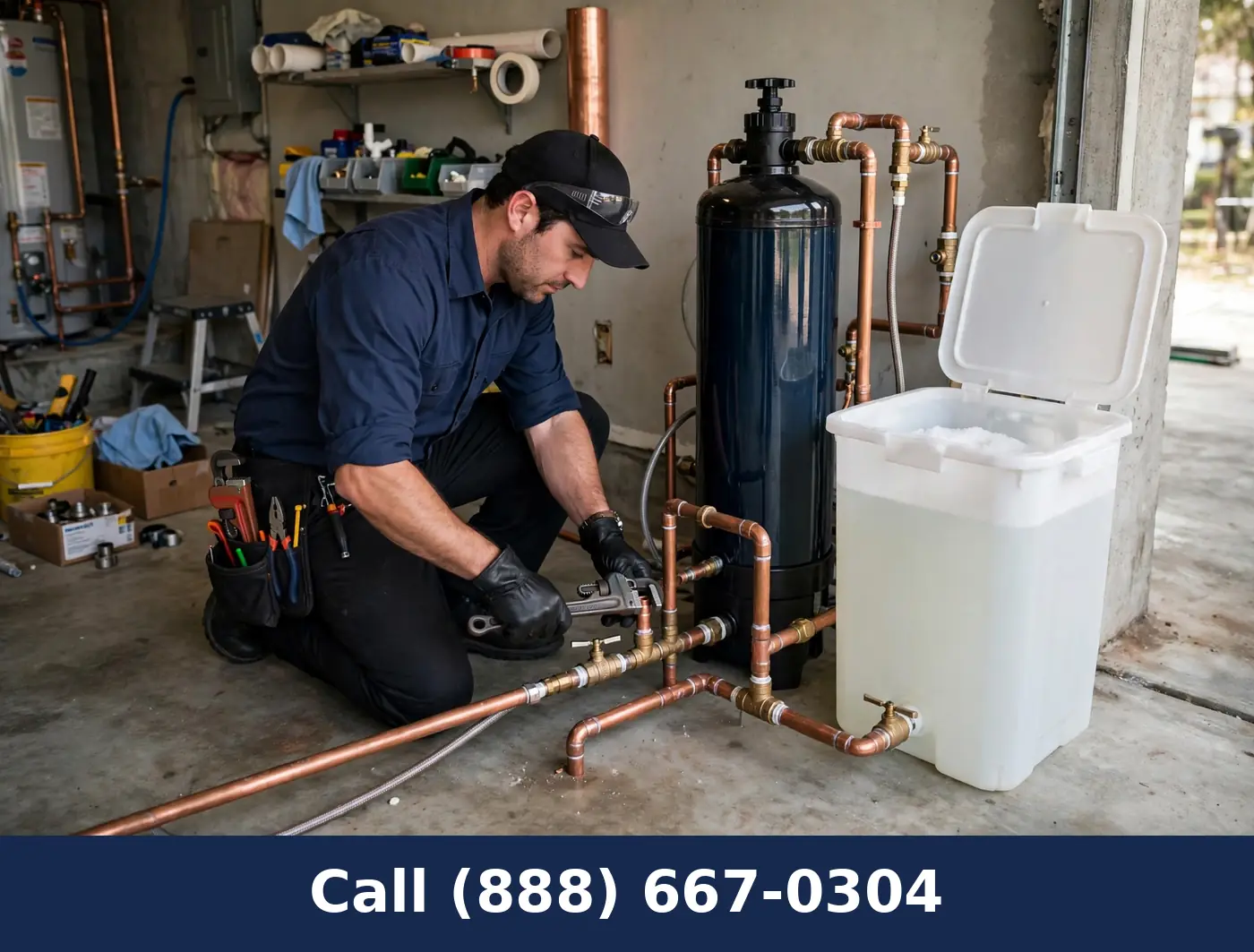
The softener installs on the main water line where it enters the home, after the pressure regulator and before the water heater, so every indoor fixture gets softened water. Outdoor hose bibs are usually left on hard water, since lawns and cars do not need softening and it saves salt. The installation needs three things at the location: the water lines themselves, a drain for the regeneration discharge, and an electrical outlet for the control valve. A bypass valve is plumbed in so the softener can be isolated for service without shutting off water to the house. The regeneration drain line runs to a suitable drain with an air gap, so wastewater can never siphon back into the system. Once plumbed, the control valve is programmed with your hardness setting and household size. The brine tank is filled with salt, and the system runs its first regeneration to put the resin into service.
What is the difference between softener types?
The most common residential setup pairs a resin tank with a separate brine tank and an automatic control valve. Metered, or demand-initiated, valves regenerate based on the actual volume of water used, which saves salt and water compared to simple timer models that regenerate on a fixed schedule. Cabinet-style all-in-one units combine both tanks in a single housing and suit tight spaces, though their smaller valves can restrict flow in larger homes. Salt-based ion exchange is the proven method for actually removing hardness. So-called saltless conditioners do not remove minerals; they claim to change how minerals behave, which is a different thing entirely. Plumber Modesto Pros installs true ion exchange softeners and will explain the options honestly during the visit.
How do you care for a water softener after installation?
The main job is keeping salt in the brine tank. Check the level monthly and keep it at least half full with the right salt for your unit, usually solar salt crystals or pellets. Do not let the tank run dry, and do not overfill it past the manufacturer's line. Once a year, the brine tank benefits from a cleaning to remove sediment. Watch for salty-tasting water, which can mean the rinse cycle needs attention, and for hardness creeping back, which can mean the resin needs cleaning or the settings need adjusting. The bypass valve should be exercised occasionally so it does not seize. With basic attention, the resin bed lasts many years and the system runs with little fuss.
What affects the cost of a water softener installation?
System capacity is the main variable. Larger grain capacity and higher-flow valves cost more than compact units. The installation location matters: a garage with the main line, a drain, and an outlet nearby is straightforward, while a location needing new drain routing or electrical work adds scope. Whether outdoor bibs are replumbed around the softener, the type of salt the system uses, and any pre-filtration for sediment or chlorine all factor in. For an exact figure for your home, call (888) 667-0304 and describe your water and your space.
Why have Plumber Modesto Pros install your water softener?
A softener only works as well as its sizing, its plumbing, and its programming. Plumber Modesto Pros tests your water first and sizes the system from real hardness and usage numbers. The plumbing includes a proper bypass and an air-gapped drain, and the control valve is programmed to your conditions. The result is soft water at every tap, scale no longer building in your heater and appliances, and a system that regenerates on its own without wasting salt. Call (888) 667-0304 to start with a water test and a correctly sized installation.
Features
- Water hardness testing to size the system correctly
- Grain capacity matched to household size and water use
- Installation on the main line after the pressure regulator
- Bypass valve included for service without losing water
- Regeneration drain run with a proper air gap
- Control valve programmed to your hardness and usage
- Outdoor hose bibs left on unsoftened water where preferred
Benefits
- An end to the scale crusting your fixtures and showerheads
- Softer-feeling water for bathing and laundry
- Longer life for your water heater and appliances
- Spotless dishes and cleaner glassware
- Less soap and detergent needed for the same clean
- A system sized to your home's actual hardness and usage
- Professional setup with bypass, drain, and programming done right