
Water Heater Earthquake Strapping Near Me
Starting price: Call for pricing
California requires water heaters to be strapped against earthquake movement, and many older installations lack proper bracing. Plumber Modesto Pros installs code-compliant seismic straps anchored to wall framing. Call (888) 667-0304 to secure your water heater before the ground moves.
Why do water heaters need earthquake strapping?
A water heater is a tall, heavy cylinder full of water, and in an earthquake it behaves exactly as physics predicts: it tips over. When a water heater falls, it tears the gas line, the water lines, and the electrical connections with it. A ruptured gas line can ignite, turning earthquake damage into a fire. A torn water line floods the surrounding area, adding water damage to the structural damage the quake already caused. Past California earthquakes have repeatedly shown unstrapped water heaters walking across garages and toppling, which is why the state made strapping mandatory.
California Health and Safety Code Section 19211 requires water heaters to be anchored or strapped to resist horizontal displacement during earthquake motion. Home sellers in California must also state in writing that the water heater bracing requirements have been met. That disclosure rule makes missing or inadequate strapping one of the most common findings in real estate transactions. Plumber Modesto Pros installs strapping that meets the state's specifications, protecting both the home and the transaction.
What does proper strapping look like?
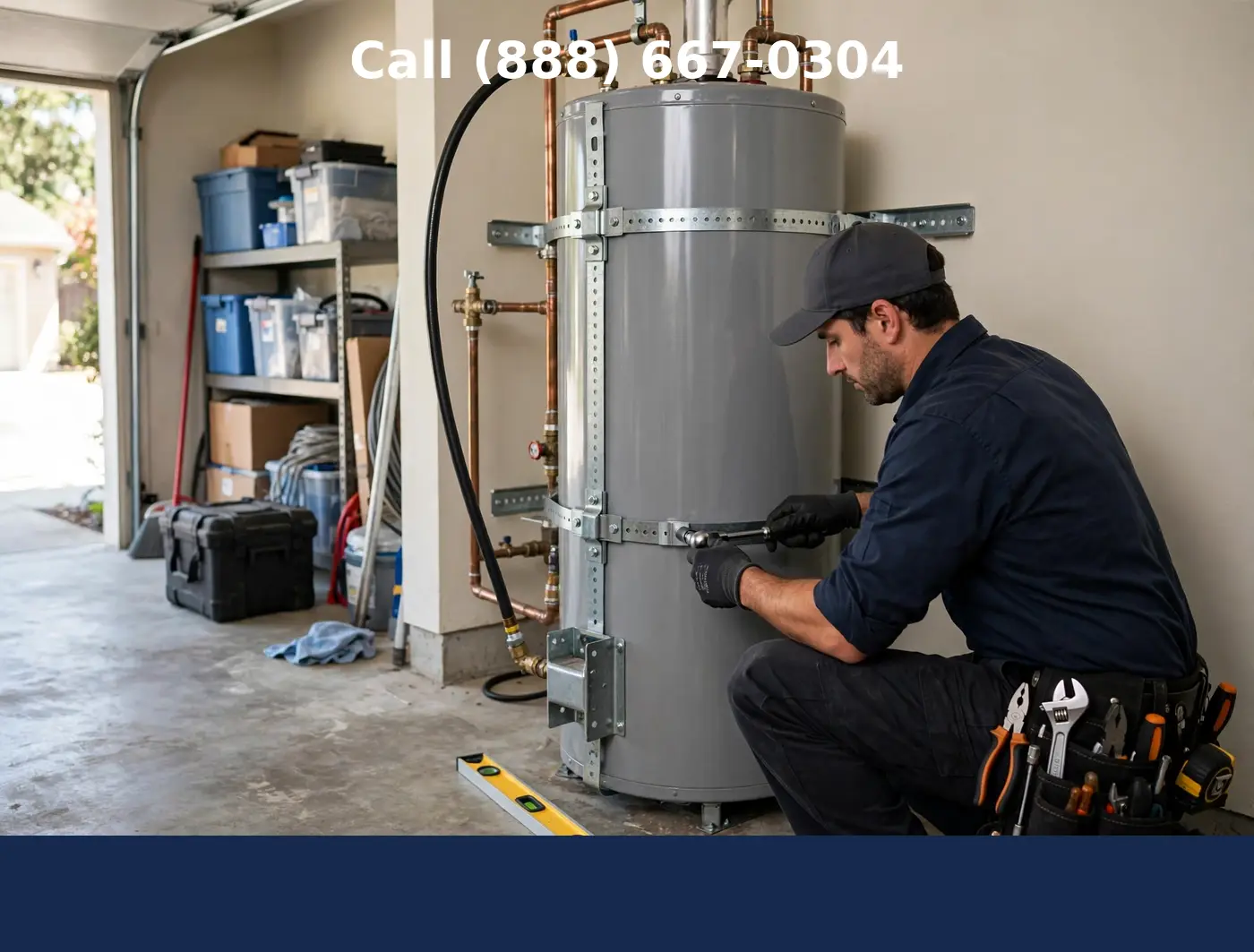
The code calls for a minimum of two straps: one in the upper third of the tank and one in the lower third. The lower strap must sit at least four inches above the water heater's control unit, so it does not interfere with the equipment's operation. The straps wrap the tank and anchor to the structural framing of the wall, meaning the wood studs, not just the drywall. Anchoring into drywall alone is useless in a quake, because the drywall tears away from the studs under load.
The hardware matters as much as the placement. Lag screws at least one-quarter inch in diameter anchor the straps, with a minimum of one and a half inches of thread penetration into the wall stud. A large flat washer sits between each screw head and the strap to spread the load and prevent pull-through. The strap material itself must be heavy-gauge metal, at least 22 gauge and three-quarters of an inch wide for wraparound installations. Perforated plumber's tape is not acceptable for water heaters over 40 gallons. For larger tanks up to 75 gallons, a third strap at mid-height is recommended. These are precise specifications, and getting them right is the difference between strapping that holds and strapping that fails.
When should you have strapping installed or checked?
Any water heater without visible straps needs them, regardless of the tank's age. Many older installations predate the strapping requirements or were installed by homeowners who skipped the bracing. Real estate transactions are the most common trigger: the buyer's inspector notes missing or inadequate strapping, and it must be corrected before closing. Water heater replacements are another natural moment, since the new tank should be strapped as part of the installation.
Existing strapping deserves inspection too. Straps anchored only to drywall, straps made from light perforated tape, or a single strap on a tall tank all fall short of the requirements. Straps can also loosen over time or get removed during nearby work and never replaced. A quick check confirms whether the installation meets the two-strap, stud-anchored standard. If it does not, upgrading the strapping is a compact job that removes a significant risk.
How does the installation work?
The visit starts with an assessment of the water heater's location and the surrounding wall structure. Plumber Modesto Pros locates the wall studs on both sides of the tank, since the straps must anchor into solid framing. If the heater sits in a location with no nearby wall, blocking or bracing is added to create proper anchor points. The existing installation is checked for any other code issues while the technician is there, such as the relief valve discharge piping.
Installation itself is straightforward. The straps are positioned at the upper and lower thirds of the tank, wrapped snugly, and secured with lag screws driven into the studs with washers in place. The lower strap is kept at least four inches above the control unit. The gas flex connector and water connections are checked for sound condition, since a strapped tank still needs intact connections to be safe. Before leaving, the technician confirms the tank cannot shift and walks you through what was installed.
What affects the cost of strapping?
The location of the water heater is the main variable. A tank in a garage against a framed wall is the simplest installation, with studs readily available on both sides. A heater in a tight closet or an unusual location may need additional blocking to create anchor points. The size of the tank matters slightly, since larger tanks call for heavier strapping and sometimes a third strap. If the existing installation has other deficiencies, such as a missing drain pan or improper relief valve piping, addressing those at the same time is the practical move.
In most homes, seismic strapping is a single-visit job with a defined scope. The assessment, the hardware, and the installation are all completed in one appointment. For real estate transactions on a deadline, that simplicity matters: the citation is resolved, the written disclosure requirement is satisfied, and the sale proceeds.
How does Plumber Modesto Pros protect your water heater?
Water heaters across the area, in garages, closets, and utility rooms, need proper seismic bracing under California law. Plumber Modesto Pros installs and upgrades earthquake strapping to the state's specifications, anchored to structural framing with proper hardware. Whether you are selling a home, replacing a heater, or simply want the protection in place, the work is done correctly in a single visit.
Need your water heater strapped for earthquakes? Call (888) 667-0304. Plumber Modesto Pros will secure your tank to code specifications and give you one less thing to worry about.
What do homeowners ask about earthquake strapping?
Does my water heater really need straps? In California, yes, because bracing is required by state law. The deeper reason is safety: an unsecured tank can topple in a quake and rupture its gas and water connections.
My tank has one strap. Is that enough? The standard calls for two straps at minimum, one high and one low on the tank. A single strap leaves the tank under-secured, Plumber Modesto Pros can add the second strap and verify the anchoring.
Will strapping work in my garage? Most garage installations strap directly to the framed wall behind the tank. If the heater sits away from a wall, blocking is added to create anchor points. The assessment determines the right approach for your setup.
Features
- Two-strap seismic bracing installation
- Straps anchored to structural wall studs
- Upper-third and lower-third strap placement
- Heavy-gauge metal strap kits
- Washer and lag-screw anchoring
- Gas line flex connector check
- Existing strap inspection and upgrades
Benefits
- Water heater secured against tipping in a quake
- Strapping placed to California code specifications
- Anchors set into studs, not just drywall
- Gas line rupture risk reduced
- Water damage from a fallen tank prevented
- Real estate transactions cleared of this citation
- Done in a single visit in most homes