Tree Root Removal from Sewer Lines Near Me
Starting price: Call for pricing
Tree root removal clears the root masses that grow inside sewer lines and block wastewater flow. Plumber Modesto Pros uses professional cutting and hydro jetting equipment to slice through root intrusions and scour the pipe walls clean. A camera inspection shows exactly where roots entered, so you can decide whether clearing is enough or the pipe needs a structural fix.
Why do tree roots invade sewer lines?
Roots are drawn to moisture, and a sewer lateral is a steady source of it. Even a hairline crack or a slightly open joint in a clay or cast iron pipe releases enough moisture to attract nearby roots. The fine root tips slip through the opening and find a constant supply of water and nutrients inside the pipe. What starts as a few wispy strands grows into a branching mass that traps paper, grease, and waste as it thickens.
Modesto's mature street trees and large yard trees make this a chronic local problem. Older neighborhoods carry clay laterals whose joints were never sealed against root entry the way modern pipe is. Once roots enter, the mass expands and wedges joints wider apart, which admits more moisture and invites more roots. The pipe did not fail because of the roots alone; the roots exploited a weakness that was already there and made it worse.
What are the signs of root intrusion in a sewer line?
The classic sign is a drain that clogs, gets cleared, and clogs again on a predictable cycle. Multiple fixtures slowing at once, toilets gurgling when other fixtures drain, and sewage backing up into the lowest drain during heavy water use all point to a main-line obstruction. If the timing lines up with the growing season, when trees push new root growth, suspicion grows stronger.
A plumber's snake that keeps pulling back root fibers is telling you exactly what it found. So is a cleanout that overflows after the yard has been heavily watered, since the roots drink and swell. These symptoms describe a living blockage, not a one-time clog, and they respond only to professional removal followed by a look at the pipe itself.
How does professional root removal work?
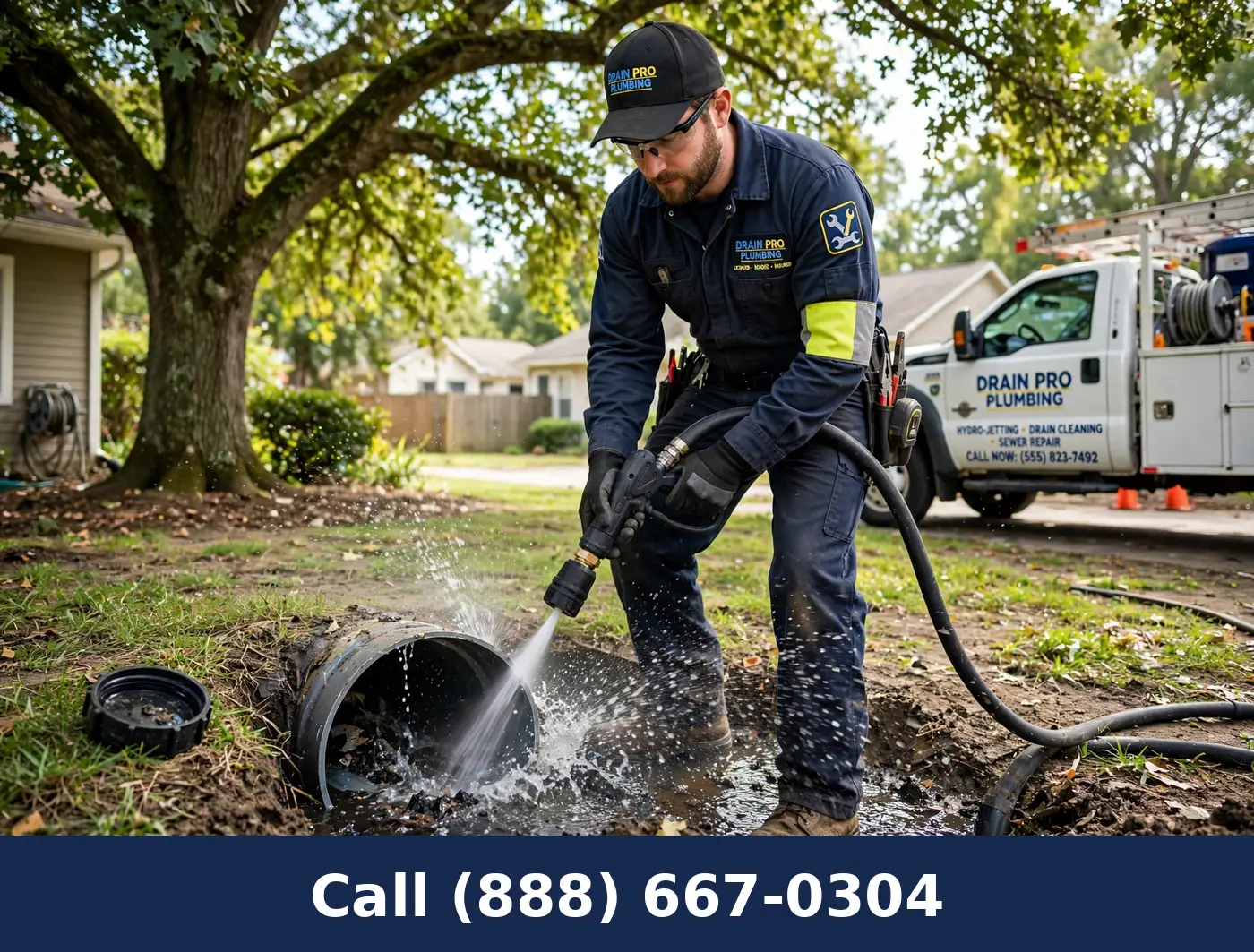
The visit starts with a camera inspection that shows the size and location of each root mass and the condition of the pipe behind it. For dense root balls, we begin with a mechanical cutting head that chews through the thickest growth. Then hydro jetting takes over. A hose with a specialized root-cutting nozzle blasts high-pressure water in multiple directions, slicing the remaining roots and scouring the full inner circumference of the pipe.
This two-stage approach matters because snaking alone only punches a hole through the center of the mass. The remaining root shell quickly regrows and the clog returns. Hydro jetting removes the roots from the pipe walls entirely and flushes the debris downstream, restoring the pipe to nearly its original inner diameter. A second camera pass confirms the walls are clean and shows the entry points the roots used.
Why does clearing alone not solve the problem?
Cutting roots out of a pipe does nothing to the crack or open joint they entered through. The moisture still escapes, the opening still sits there, and the tree still stands nearby. Given time, new root tips find the same entry and the cycle restarts. This is the most important thing to understand about root removal: clearing restores flow, but only sealing the entry points stops the recurrence.
That is why the post-clearing camera footage matters so much. It shows whether the pipe walls are sound enough that periodic clearing will keep you comfortable. It also reveals whether the damage is severe enough to justify trenchless lining or a section replacement. Some homeowners choose scheduled cleanings as an ongoing maintenance strategy. Others prefer a structural fix that ends the cycle. Both are legitimate, but the decision should come from evidence rather than hope.
What can you do to manage roots around your sewer line?
Start by knowing where your lateral runs and which trees stand near it, since the trees closest to the line are the usual suspects. Be cautious about planting aggressive species near the sewer route; thirsty ornamentals and large shade trees send roots far in search of water. Keep the ground over the line reasonably watered so roots do not have to hunt as hard, and avoid driving heavy equipment over shallow pipe sections.
Chemical root killers sold to homeowners deserve caution. They can damage landscaping, harm the beneficial bacteria in septic systems, and only reach the roots they touch without fixing the pipe. Professional removal paired with a camera assessment beats repeated chemical treatments every time. When a structural repair is the right move, lining or bursting seals the pipe so roots have nothing to exploit.
What affects the cost of tree root removal?
The extent of the intrusion is the biggest factor. A few strands at one joint clear quickly, while a dense mass filling several feet of pipe takes serious cutting and jetting time. Pipe length matters because a long lateral with roots at multiple points requires more work than a short run. Access through a clear exterior cleanout keeps setup simple, while interior access adds handling time.
The condition of the pipe itself can change the approach, since cracked or fragile pipe needs gentler methods than sound pipe. If a clearing pass must come before the camera can even see the walls, that adds a step. When the inspection reveals damage worth repairing, the structural work is scoped separately. We explain what the camera shows and what each option involves before you decide.
Which trees cause the most trouble for sewer lines?
The worst offenders are large, thirsty trees planted close to the lateral. Big shade trees with far-reaching root systems and ornamental species known for aggressive surface roots both send growth toward the moisture escaping from pipe joints. A tree does not need to stand directly over the line; roots routinely travel well beyond the drip line of the canopy.
If you are planting new trees, keep them as far from the sewer route as your yard allows and choose species with less aggressive root habits. For existing trees near the line, periodic camera checks catch root entry while it is still a few strands rather than a full blockage. Managing the trees and monitoring the pipe together is the most effective long-term strategy.
How does Plumber Modesto Pros handle tree root problems around Modesto?
Plumber Modesto Pros handles tree root problems across Modesto and the surrounding Central Valley, where mature trees and clay laterals make this one of the most common service calls we receive. Our technicians arrive with cutting equipment, hydro jetting rigs, and camera gear on the same visit whenever possible. We show you the root masses on the monitor, clear them thoroughly, and then show you the clean pipe and the entry points.
Call (888) 667-0304 when your drains start their familiar cycle of clogging and clearing. We will find the roots, remove them completely, and give you a straight answer about whether clearing or a structural fix is the right long-term move for your line.
Features
- Camera inspection that maps every root entry point and mass
- Professional root-cutting auger heads for dense root balls
- High-pressure hydro jetting that scours the full pipe circumference
- Specialized root-cutting nozzles designed for sewer line work
- Clearing that restores the pipe to its full inner diameter
- Post-clearing camera pass showing the clean pipe walls
- Honest assessment of whether the pipe needs structural repair
Benefits
- Restore full flow through a line choked with root masses
- Stop the backups that roots cause during heavy water use
- Protect the pipe from roots wedging joints apart
- Get visual proof of the root damage the camera finds
- Plan maintenance around your trees instead of emergency calls
- Pair clearing with a structural fix that ends the cycle
- Keep sewage where it belongs, moving away from your home
Frequently asked questions
Will the roots grow back after removal?
Yes, roots enter through tiny cracks and unsealed joints, and clearing does not seal those openings. Without a structural fix like lining or a section replacement, roots typically grow back through the same entry points.
Is hydro jetting better than snaking for roots?
Hydro jetting with a root-cutting nozzle scours the full pipe wall and clears the mass completely. Snaking only punches a hole through the center, leaving most of the root ball to regrow quickly.
Can hydro jetting damage older pipes?
Yes, when the pipe is cracked, collapsed, or made of fragile material. We always run a camera first and choose the clearing method the pipe can handle safely.
Do tree roots break into healthy pipes?
Roots rarely break into a completely intact pipe. They enter through existing cracks and loose joints, attracted by the moisture escaping. What looks like a root attack is usually roots exploiting a weakness that was already there.
How often should I have roots cleared?
Homes with known root problems or large trees near the lateral benefit from periodic camera checks and cleanings. Your technician can recommend a rhythm based on what the camera shows.