
Toilet Installation Near Me
Starting price: Call for pricing
A new toilet should fit your bathroom, sit rock solid, seal perfectly at the floor, and flush with authority. Plumber Modesto Pros installs new and replacement toilets with careful flange work, proper sealing, and thorough testing. Call (888) 667-0304 to schedule your toilet installation.
How do you know which toilet will fit your bathroom?
The most important measurement is the rough-in: the distance from the finished wall behind the toilet to the center of the closet bolts on the floor. Most bathrooms use a 12-inch rough-in, but 10-inch and 14-inch rough-ins are common in older homes and some remodels. A toilet built for the wrong rough-in either will not fit or will sit too far from the wall, wasting space. Measuring before you buy avoids the most common installation headache.
Bowl shape and height matter for comfort and space. Elongated bowls are more comfortable for most adults but extend a few inches further into the room, which can matter in a tight powder room. Comfort-height or chair-height models sit a couple of inches taller than standard, which many people find easier to use. Plumber Modesto Pros can confirm your rough-in and clearances before you purchase, so the toilet you bring home is the one that fits.
What happens to the old flange and wax ring?
Every toilet installation starts at the floor. The old toilet is removed, the old wax is scraped away, and the closet flange is inspected closely. The flange is the fitting that connects the toilet to the drain line and anchors the closet bolts, and its condition determines whether the new toilet will seal. A cracked flange, a flange with broken bolt slots, or one sitting too far below the finished floor has to be repaired or raised. A new toilet on a bad flange will leak from day one.
Flooring changes often create flange height problems. When new tile or vinyl goes over an old floor, the flange ends up recessed, and a standard wax ring cannot bridge the gap. Flange extenders or spacer rings bring the flange up to the right height so the seal compresses evenly. This detail takes a few extra minutes during installation and prevents the slow hidden leaks that ruin subfloors.
What makes a water-efficient toilet work well?
Modern water-efficient toilets use 1.28 gallons per flush or less, compared to 3.5 gallons or more on toilets from decades past. And the good ones flush better than the old water hogs they replace. The improvement comes from redesigned bowls, larger trapways, and better-engineered flush valves that move water with more force. Look for the WaterSense label, which marks models independently tested for both efficiency and flush performance.
Not every low-flow toilet performs equally, which is why model choice matters. Glazed trapways resist buildup, fully-glazed bowls rinse more completely, and pressure-assisted models offer extra clearing power for busy households. Dual-flush toilets add a light-flush option for liquid waste, cutting water use further in homes where people actually use both settings. A plumber who has installed hundreds of toilets can steer you toward models that perform reliably in real bathrooms.
Why does leveling matter so much with toilets?
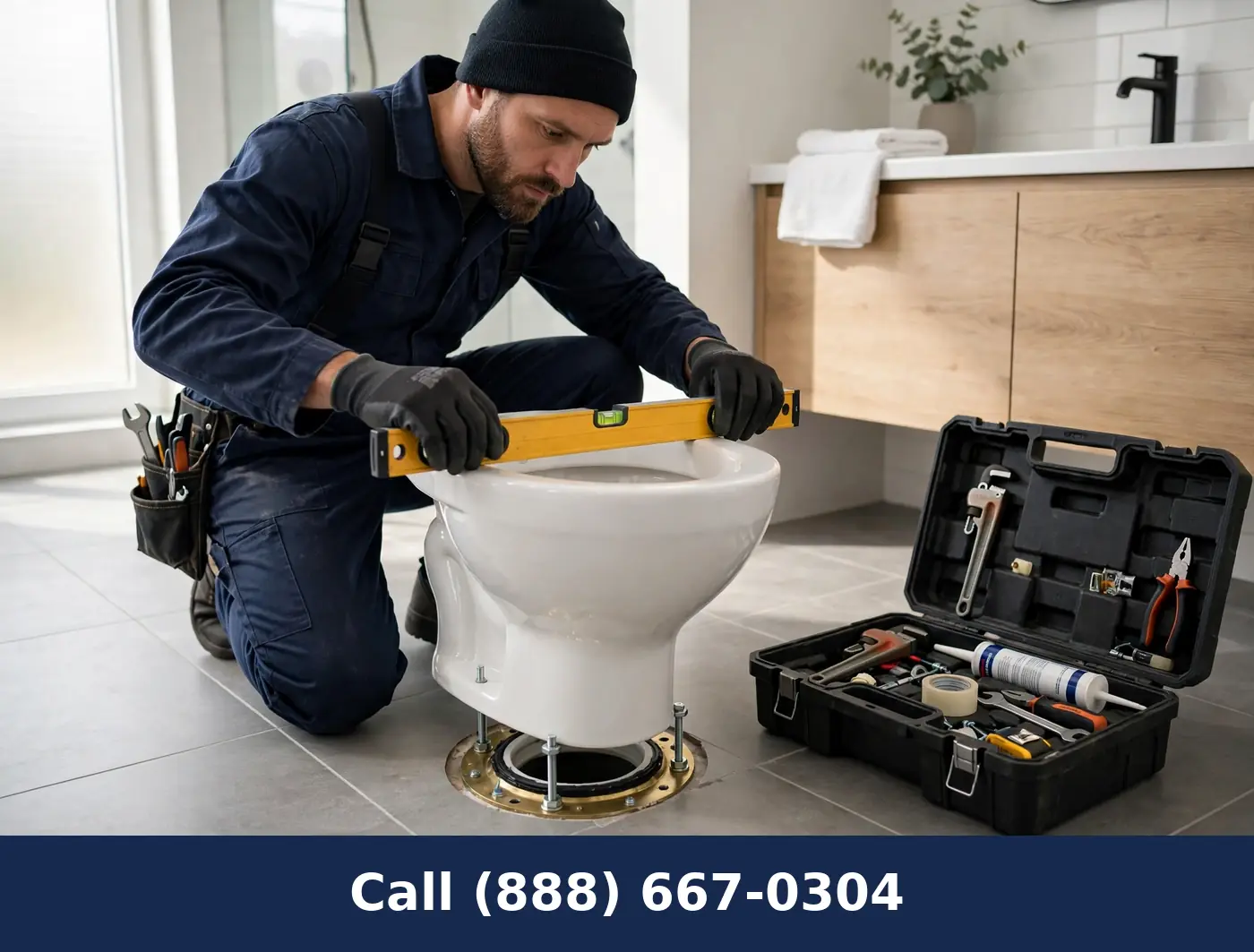
Toilets are made of vitreous china, which is strong under compression but cracks if it is stressed unevenly. A toilet that is not level rocks, and rocking breaks the wax seal and can eventually crack the base. Leveling starts with checking the floor itself: many bathroom floors slope slightly, especially in older homes. Plastic shims placed under the base take up the gaps, and the excess is trimmed after the toilet is bolted down.
Bolt tightening is part of the same discipline. The closet bolts should be snugged down gradually, alternating sides, until the toilet is stable. Overtightening is one of the most common causes of cracked toilet bases, and it is completely avoidable with a careful hand. Once the toilet is stable and sealed, the base is caulked around the front and sides, leaving the back open so any future leak shows itself instead of hiding.
What does the installation visit involve?
The visit begins with shutting off the water, draining the old toilet, and removing it without damaging the floor or the flange. After the flange inspection and any needed repair, the new wax ring or seal goes on, the closet bolts are set. And the new toilet is lowered straight down onto the bolts in one careful motion. There is no second chance with a wax ring. Once it compresses, lifting the toilet means starting over with a new ring, so placement has to be right the first time.
Then the tank is attached on two-piece models, the supply line is connected, the water is turned on. And the toilet is flushed repeatedly while every connection is checked for leaks. The fill level is adjusted, the handle or flush mechanism is tested, and the bolt caps go on. The old toilet is removed from the home for disposal. Call (888) 667-0304 and get a toilet installed the right way, from flange to final flush.What should you know about the supply line and shutoff?
Every toilet installation includes a look at the water supply connection, because the supply line and shutoff valve are as important as the toilet itself. The supply line runs from the shutoff valve on the wall or floor up to the toilet's fill valve. Older lines made of rigid plastic or unbraided material become brittle over time. A new braided stainless steel supply line is standard with every installation, since it resists bursting and connects with fresh, reliable fittings. The shutoff valve gets the same scrutiny.
Angle-stop valves that have not been turned in years often seize, and a valve that cannot fully stop the water is a liability during any future repair. When the existing valve is questionable, it is replaced with a modern quarter-turn ball valve while the water is already off for the installation. This takes a few extra minutes and gives you a valve that turns easily and shuts off completely. After everything is connected, the supply side is tested just as carefully as the drain side.
The valve is opened slowly, the line is watched for weeping at both ends, and the fill valve is checked for proper shutoff at the correct water level. A dry connection at the wall and a quiet, complete fill complete the job. These are small details, but supply-line failures cause some of the most damaging bathroom floods, so they are never skipped.
Features
- Full toilet replacement including old toilet removal and haul-away coordination
- Water-efficient and dual-flush model installation
- Comfort-height and standard-height toilet options
- Flange inspection, repair, and height correction
- New wax ring or silicone seal, closet bolts, and supply line
- Rough-in measurement and fit verification before purchase guidance
- Complete leak testing and flush performance check
Benefits
- A toilet that sits level and never rocks
- A watertight seal that protects your floor
- Lower water use with modern efficient models
- Flush performance matched to your drain system
- Clean, careful work with the old unit removed
- Guidance on choosing the right model for your space
- Every connection tested before the job is done
Frequently asked questions
How do I measure my toilet rough-in?
Measure from the finished wall behind the toilet to the center of the closet bolts at the base. Most toilets need 12 inches, but 10-inch and 14-inch models exist for non-standard bathrooms. Measure before buying.
What is comfort height, and is it right for me?
Comfort-height toilets have a bowl about 17 to 19 inches high, similar to a dining chair, versus about 15 inches for standard models. Many adults find them easier to sit and stand from, though shorter users sometimes prefer standard height.
Can a bidet seat be added to a new toilet?
Most bidet seats fit standard two-piece and many one-piece toilets, but bowl shape and tank style matter. If a bidet seat is in your plans, mention it before the toilet is chosen so the model is compatible.
What happens to my old toilet?
The old toilet is removed from the bathroom and taken away for disposal. Porcelain is heavy and awkward, so removal is handled carefully to protect floors, doorways, and walls on the way out.
Do I need a new supply line with a new toilet?
A new braided stainless supply line is standard practice with every installation. Old rigid or corroded supply lines are a common source of leaks, and replacing them while the toilet is out is simple and sensible.