
Tankless Water Heater Repair & Descaling Near Me
Starting price: Call for pricing
Tankless water heater repair and descaling covers diagnosis of error codes and performance problems plus the mineral flush that hard water makes necessary. Plumber Modesto Pros services tankless units across Modesto, clearing scale from heat exchangers and repairing components such as igniters, sensors, and valves.
Why do tankless water heaters need descaling?
Modesto's water carries dissolved calcium and magnesium, and tankless heat exchangers run hot enough to bake those minerals onto their inner surfaces. The waterways inside a tankless unit are narrow, so even a thin layer of scale restricts flow and insulates the metal from the water it must heat. Efficiency drops, and the unit works harder to deliver the same temperature.
Scale buildup shows up as gradual symptoms. Hot water takes longer to arrive, temperatures swing during a shower, or the unit shuts off mid-use and throws an error code. Many brands display a scale-related code, such as the LC code on some popular models, when the heat exchanger needs attention. These are maintenance signals, not death sentences, when addressed promptly.
Left alone, heavy scale can overheat the exchanger and damage components that a simple flush would have protected. Annual descaling in hard water areas prevents that outcome. Homes with very hard water do better on a six-month cycle. Your technician can gauge your interval from the amount of scale removed at each visit.
What does a professional descaling involve?
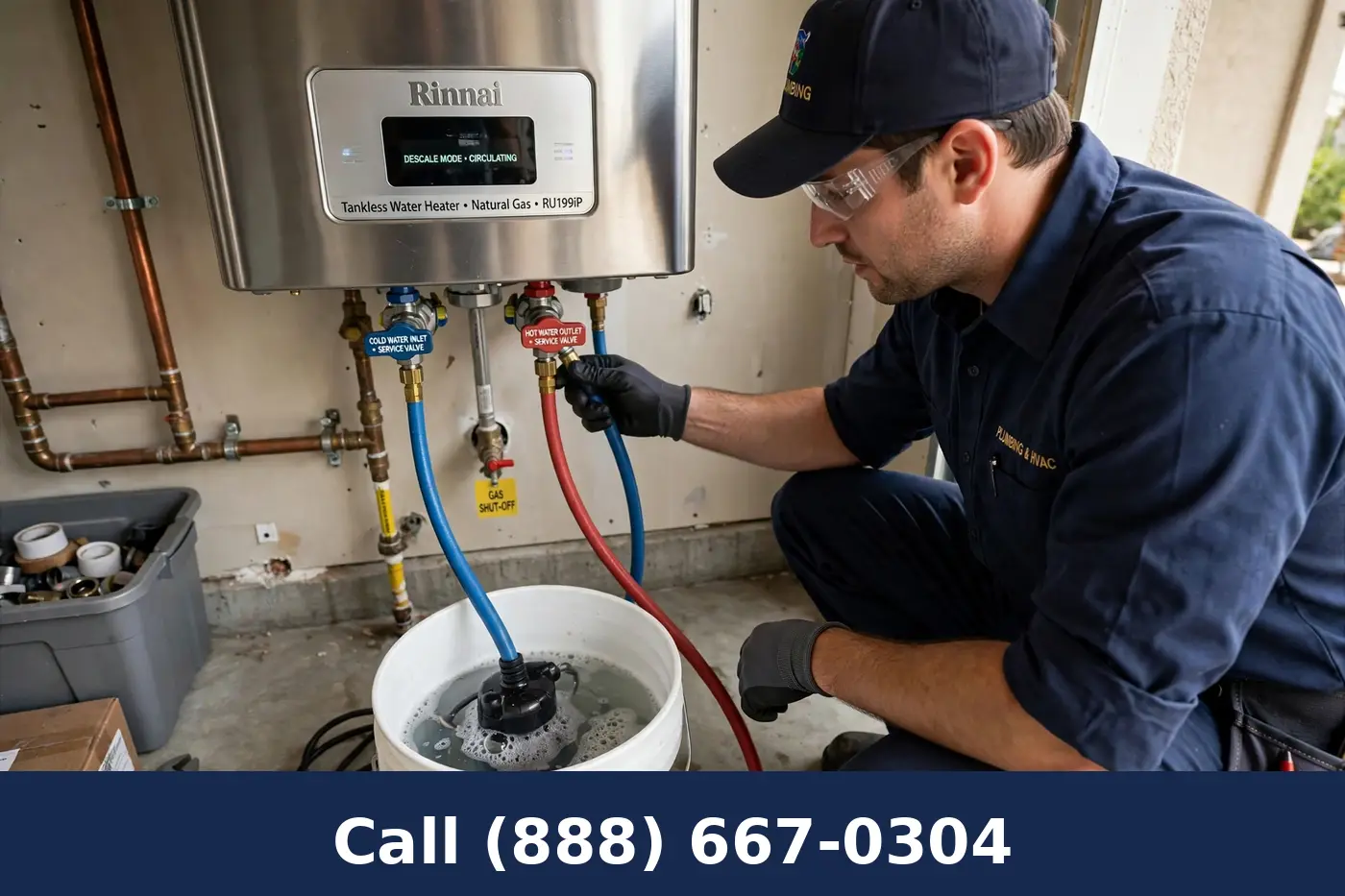
The visit starts with the unit powered down and isolated. The technician closes the hot and cold isolation valves, which separates the heater from the home's plumbing while leaving the service ports accessible. Hoses connect the cold and hot service valves to a submersible pump sitting in a bucket of descaling solution. This creates a closed loop through the heat exchanger.
The pump circulates the solution for 45 to 60 minutes. During that time, the mild acid dissolves the mineral layer without harming the copper or stainless steel inside. The technician monitors the process and inspects the service valves, the inlet filter, and visible fittings while the flush runs. After circulation, the system is flushed with clean water for several minutes to clear every trace of solution.
Then the hoses come off, the valves reopen, and power and gas are restored. The technician runs hot water at several fixtures to confirm stable temperature and proper flow. The whole visit typically takes about 90 minutes. It is straightforward work, but it requires the right pump, hoses, and solution, plus familiarity with each manufacturer's valve layout.
What repairs do tankless units commonly need?
Ignition problems top the list. A worn igniter or a dirty flame sensor prevents the burner from lighting reliably, producing intermittent hot water or lockout codes. These are inexpensive components, and replacing them restores normal operation quickly. The technician tests ignition through several cycles to confirm the fix.
Flow sensors and temperature sensors fail less often but cause confusing symptoms when they do. A faulty flow sensor may not detect that a tap opened, so the unit never fires. A bad temperature sensor reports incorrect readings, causing overheating or lukewarm output. Diagnosis involves testing each sensor against its specification rather than guessing.
Gas and venting issues also surface. An undersized gas line that was marginal at installation starves the burner under full demand, mimicking a failing unit. Blocked or improperly terminated venting trips safety switches. Condensing models can clog at the condensate trap, backing acidic water into the unit. A thorough technician checks these systems before condemning parts.
Water quality devices deserve attention too. The inlet filter traps sediment before it reaches the exchanger, and a clogged filter chokes flow across the whole house. Cleaning it takes minutes during a service visit. Homes with a softener or scale filter upstream should have those checked as well, since a depleted softener lets hardness through to the heater.
When is repair the wrong call?
A unit approaching 20 years with a failed heat exchanger is usually beyond economical repair. Heat exchangers are the most expensive component, and replacing one in an aging unit rarely makes sense compared to a new heater. Multiple simultaneous failures in an old unit point the same way. Your technician will say so plainly and price both paths.
Newer units with a single failed component are almost always worth repairing. Igniters, sensors, valves, and control boards are serviceable parts with reasonable costs. The decision hinges on the unit's age, its maintenance history, and the cost of the repair relative to replacement. You get both numbers and an honest recommendation.
How often should descaling be scheduled?
Water hardness sets the schedule. In soft water areas, every two years can suffice. Moderate hardness calls for annual service. Hard water, which describes much of Modesto and the Central Valley, needs descaling every six to twelve months. Usage matters too: a large household pushing more gallons through the unit accumulates scale faster.
Your technician documents what comes out at each visit, which lets the interval be tuned to your home rather than a generic chart. Some manufacturers require documented professional maintenance to keep their heat exchanger coverage valid, so keeping receipts matters. A service plan takes the scheduling off your plate entirely.
What can homeowners do between visits?
Watch for the early signs: longer waits for hot water, temperature fluctuation, new noises, or any error code on the display. Note the code exactly as shown before resetting anything, since it guides the diagnosis. Keep the area around the unit clear and the vent termination clear of plants, stored items, and debris.
Do not attempt internal repairs yourself. Gas connections, high-voltage ignition components, and sealed combustion chambers are not homeowner territory. Annual professional service plus prompt attention to symptoms is the formula that keeps a tankless heater healthy for its full 15 to 20 year lifespan.
How does Plumber Modesto Pros service tankless units in Modesto?
Plumber Modesto Pros repairs and descales tankless water heaters throughout Modesto and surrounding communities. Technicians arrive with descaling equipment, common replacement parts, and the diagnostic approach to find root causes rather than mask symptoms. Every visit ends with verified performance at your fixtures and a recommended service interval for your water conditions.
Call (888) 667-0304 when your tankless unit shows an error code, delivers uneven temperatures, or is due for its descaling. A technician will diagnose the issue, perform the flush or repair, and leave your hot water running right.
Features
- Full diagnostic of error codes, temperature swings, and ignition faults
- Closed-loop descaling flush with manufacturer-approved solution
- Service valve and isolation port inspection during the flush
- Inlet water filter cleaning to restore proper flow
- Burner, igniter, and flame sensor inspection and cleaning
- Condensate trap and drain check on condensing models
- Post-service performance test at multiple fixtures
Benefits
- Hot water temperature restored to steady and predictable
- Efficiency recovered from scale-coated heat exchangers
- Error codes resolved at their source instead of just reset
- Longer equipment life in Modesto's mineral-heavy water
- Fewer surprise cold showers during peak demand
- Maintenance history that supports manufacturer coverage
- Clear advice on the descaling interval your water needs
Frequently asked questions
How do I know my tankless water heater needs descaling?
Longer waits for hot water, temperature swings, reduced flow, and scale-related error codes are the classic signs. Visible scale on faucets and showerheads suggests the heater is accumulating it too. In Modesto's hard water, annual descaling is wise even without symptoms.
Can I descale my tankless water heater myself?
The basic flush is a documented DIY procedure for handy homeowners with isolation valves, a pump, and hoses. Repairs involving gas, ignition, or internal components should stay with a professional. Many owners prefer professional service to keep maintenance records for coverage purposes.
What does the LC error code mean?
On several major brands, LC indicates limescale buildup in the heat exchanger restricting flow or heat transfer. A descaling flush usually clears it. If the code returns quickly after a flush, the unit needs deeper diagnosis for sensor or flow issues.
Does descaling fix temperature fluctuation?
Often, yes, when scale is the cause. Mineral deposits create hot spots and uneven heat transfer that show up as swings. If fluctuation persists after a thorough flush, the technician investigates sensors, gas supply, and water pressure next.