
Tankless Water Heater Installation Near Me
Starting price: Call for pricing
Tankless water heater installation puts an on-demand unit on your wall that heats water only when a tap opens, delivering continuous hot water without a storage tank. Plumber Modesto Pros sizes the unit by flow rate and temperature rise, then handles gas line, venting, and water connections for Modesto homes.
How does a tankless water heater work?
A tankless unit stays idle until you open a hot tap. Water flows through the heat exchanger, a powerful gas burner or electric elements fire, and hot water reaches the fixture seconds later. When the tap closes, the unit shuts down. There is no tank of water sitting hot all day, which is where the efficiency advantage comes from.
The tradeoff is that the unit must heat water instantly at full flow. That demands a much larger burner than a tank heater: roughly 150,000 to 199,000 BTU versus about 40,000 for a typical storage tank. Sizing the unit correctly is therefore the most important part of the installation. An undersized unit delivers lukewarm water when two fixtures run at once, no matter how good the brand.
Tankless heaters suit households with high or unpredictable hot water demand. Back-to-back showers, a dishwasher running while someone bathes, a deep soaking tub: these are the scenarios where endless hot water earns its keep. Homes with steady, modest demand can also benefit, especially where floor space is tight.
How is the right tankless unit sized?
Sizing a tankless heater means matching two numbers: flow rate and temperature rise. Flow rate is the gallons per minute your household draws at peak. A standard shower uses about 2.5 GPM, a washing machine around 2 GPM, and a dishwasher near 1.5 GPM. Add the fixtures that run together and you have your target.
Temperature rise is the gap between incoming groundwater temperature and your desired output, usually 120 degrees. Modesto's groundwater is moderate, so the rise is smaller than in colder climates, which works in your favor. The unit must deliver your target flow at that rise simultaneously. Your installer runs these numbers with you and selects a unit that covers your real peak, not an optimistic average.
What gas and electrical work does installation require?
Gas tankless units need far more fuel than the tank they replace. A half-inch gas line that served a 40,000 BTU tank will not feed a 199,000 BTU tankless heater. Most whole-home installations need a three-quarter-inch or larger gas line, confirmed by a load calculation that accounts for run length, fittings, and every other appliance on the system. The gas meter and regulator may need an upgrade as well.
Venting is the other major consideration. Non-condensing units use stainless steel venting rated for high exhaust temperatures. Condensing models, which capture extra heat from the exhaust, can use PVC venting and reach higher efficiency. Both need a proper termination point with clearances from windows, doors, and air intakes. Your installer plans the vent route before the unit goes on the wall.
Electric whole-home tankless heaters avoid gas and venting entirely but demand enormous electrical capacity, often 100 to 150 amps at 240 volts. Most homes need a panel upgrade to support that. For that reason, gas dominates whole-home tankless installs in our area, while electric units fit point-of-use applications like a single bathroom.
What happens during the installation?
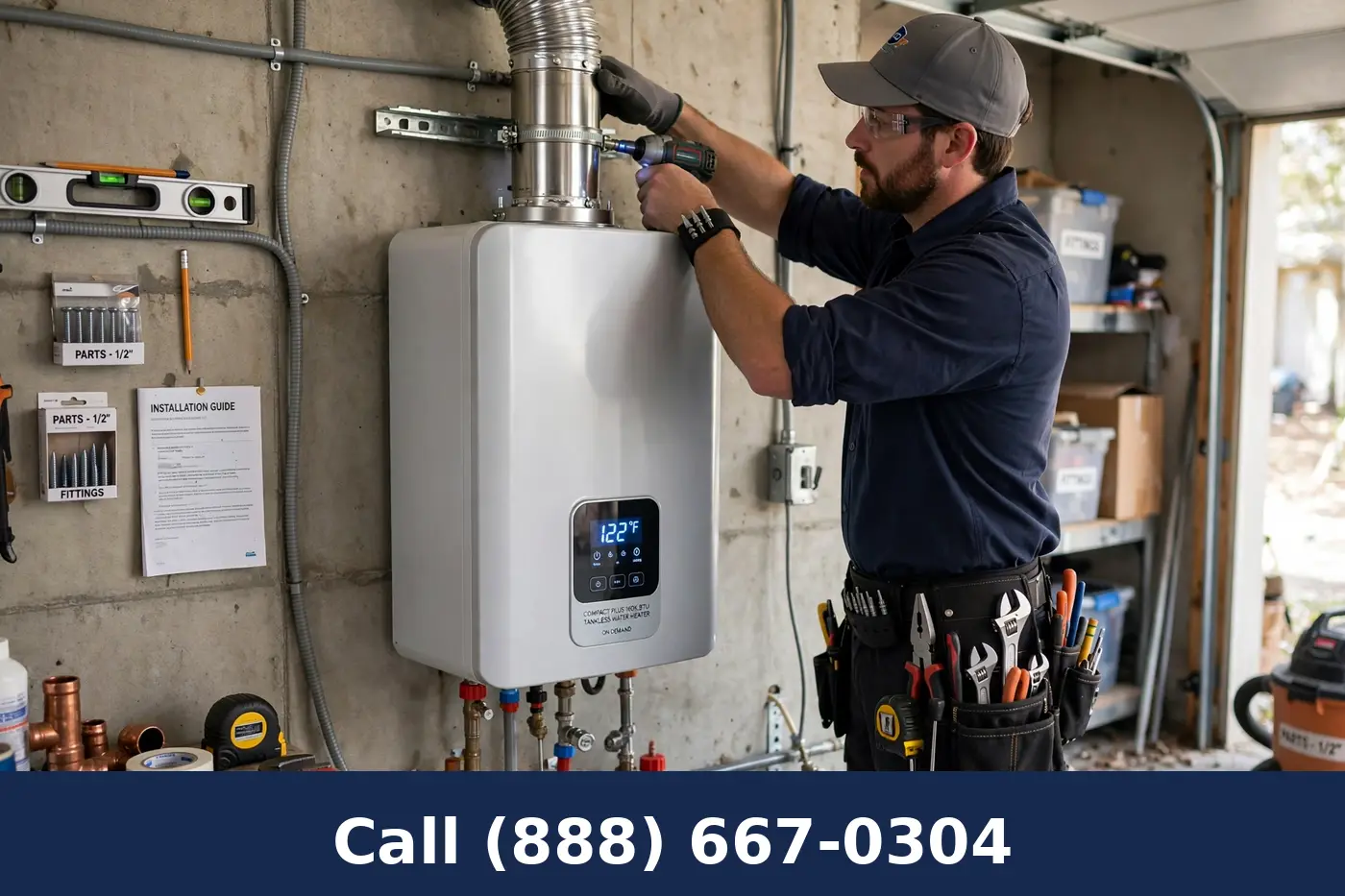
The technician mounts the unit on an exterior or interior wall with proper clearances for service access. Water lines connect through isolation service valves, which are small valves with hose bibs that make future descaling straightforward. If your home lacks them, installing the valves now saves real effort later. A sediment filter on the inlet protects the heat exchanger from debris.
The gas line is run or upsized, the vent is installed to the planned route, and condensing units get a condensate drain to carry away the acidic water they produce. The system is purged of air, powered up, and commissioned. Commissioning means running multiple fixtures, verifying the temperature holds steady, and checking for error codes. The installer also sets the output temperature, typically 120 degrees.
Why does hard water matter more for tankless units?
Tankless heat exchangers have narrow waterways and intense heat, which makes them sensitive to mineral scale. In Modesto's hard water, calcium and magnesium deposit inside the exchanger over time. Even a thin layer of scale cuts efficiency and can trigger error codes or temperature swings. This is not a flaw in the technology; it is a maintenance reality.
The defense is regular descaling, usually once a year in hard water areas. The isolation valves installed at setup let a technician circulate a descaling solution through the unit in about an hour. Some homeowners add a water softener or scale-reduction device upstream for extra protection. Your installer explains the maintenance schedule during the visit so the unit performs for its full lifespan.
Condensing or non-condensing: which is right?
Condensing tankless heaters squeeze extra heat from the exhaust gases, reaching efficiency ratings up to the high nineties. They cost more upfront and need a condensate drain, since the captured moisture is mildly acidic and must be neutralized or piped to a drain. For most households, the energy savings justify the difference over the unit's life.
Non-condensing models are simpler and less expensive. They can sometimes reuse existing B-venting in retrofit situations, which trims installation labor. Their efficiency is lower, but they remain a solid choice where the venting path favors them or the budget is tight. Your installer compares both against your home's layout and usage.
What affects the cost of a tankless installation?
The unit itself, the gas line work, and the venting route drive the scope. A home with an adequate gas line and a short, simple vent path is the straightforward case. Long gas runs, meter upgrades, difficult vent terminations, and condensate routing add labor and materials. Homes switching from electric tank to gas tankless see the most new infrastructure.
Water treatment is worth budgeting alongside the heater. A softener or descaler protects the investment and keeps the maintenance schedule reasonable. Discuss it during the assessment rather than after the install. The goal is a system that performs well for twenty years, not one that scales up in three.
How does Plumber Modesto Pros serve Modesto homeowners?
Plumber Modesto Pros installs tankless water heaters across Modesto and the surrounding Central Valley. The team handles the full scope: load calculations, gas line sizing, venting, water connections, and commissioning. Every install includes isolation valves and a plain-English explanation of the descaling schedule your water conditions require.
Call (888) 667-0304 to talk through a tankless water heater for your home. A technician will assess your gas service, calculate your flow needs, and recommend a unit sized for the way you actually use hot water.
Features
- Sizing by gallons per minute and required temperature rise
- Gas line evaluation and upsizing for 150,000 to 199,000 BTU demand
- Condensing and non-condensing model options explained
- Direct venting routed to manufacturer specifications
- Isolation service valves installed for future descaling
- Condensate drain setup for condensing units
- System commissioning with flow and temperature verification
Benefits
- Hot water that does not run out during back-to-back showers
- Energy use only when hot water is actually flowing
- Wall-mounted design that frees up floor space
- Longer equipment life than a conventional tank with proper care
- Precise temperature control at every fixture
- Scale-resistant performance when paired with regular descaling
- A clear maintenance plan explained before the technician leaves
Frequently asked questions
Will a tankless water heater really never run out of hot water?
It delivers continuous hot water as long as the total demand stays within its rated flow. If you exceed the unit's capacity by running too many fixtures at once, the temperature drops. Correct sizing for your peak demand is what makes the promise real.
How long do tankless water heaters last?
With regular descaling and maintenance, tankless units commonly serve 15 to 20 years, roughly double a conventional tank. Hard water shortens that span without maintenance. Annual service is the key to reaching the long end of the range.
Can a tankless unit replace my tank in the same spot?
Sometimes. Tankless units mount on a wall and need specific venting and gas capacity, so the old tank's location may or may not work. Your installer evaluates the space, the vent route, and the gas line before recommending placement.
Do tankless water heaters need electricity?
Yes. Even gas-fired tankless units need a standard electrical outlet for their controls, ignition, and cold-weather protection circuitry. During a power outage, a gas tankless unit will not produce hot water without backup power.