Sewer Line Repair Near Me
Starting price: Call for pricing
Sewer line repair fixes localized damage such as a cracked section, an offset joint, or a root-invaded stretch without replacing the entire lateral. Plumber Modesto Pros begins with a camera inspection to confirm the defect, then excavates and rebuilds only the affected area. This targeted approach resolves the failure while leaving the healthy portions of your line intact.
What is sewer line repair?
Sewer line repair is the targeted fix of a damaged portion of your underground sewer lateral, the pipe that carries wastewater from your home to the city main. Rather than replacing the whole run, repair focuses on the section that failed. That failure might be a crack from soil movement, a joint that shifted out of alignment, a stretch invaded by roots, or a spot where corrosion has eaten through. A technician excavates down to that section, removes the failed pipe, and installs new pipe in its place.
This approach sits between two other options. Drain cleaning clears buildup inside a pipe but cannot heal structural damage. Full replacement rebuilds the entire lateral and makes sense when damage is widespread. Repair is the middle path, and it is the right call when a camera inspection shows one or two isolated failures in an otherwise sound line.
When is a sewer line repair the right choice?
Repair fits when damage is isolated to one section while the rest of the pipe shows healthy walls on camera. A single crack from a settling sidewalk, one offset joint near a mature tree, or a short stretch crushed by heavy equipment overhead are classic repair candidates. If your backups started suddenly after years of reliable drainage, a localized failure is likely the cause.
The age and material of the pipe also guide the decision. A newer plastic lateral with one bad joint is an excellent repair candidate, since the surrounding pipe has decades of life left. Older clay lines can still be repaired at a single point, but repeated failures across the same line suggest the material is reaching the end of its service. A camera inspection makes this distinction visible rather than speculative.
What causes sewer lines to need repair?
Tree roots are the most common culprit in Modesto, where mature street and yard trees send moisture-seeking roots toward every tiny leak at a pipe joint. Once inside, roots expand and wedge joints apart, crack clay walls, and trap the grease and paper that flow past. Ground movement from Central Valley soil that swells and shrinks with the seasons can shear a pipe at its weakest joint. Heavy loads from vehicles or construction equipment passing overhead can crush shallow pipe sections.
Corrosion attacks older cast iron from the inside out, thinning the walls until they crack or collapse in a spot. Grease and scale do not break pipes themselves, but they narrow the flow path and raise pressure against weak joints. Even a minor earthquake or nearby excavation can shift soil enough to offset a joint. Most failures come from a combination of these forces acting on one vulnerable point.
What are the warning signs of a damaged sewer line?
Watch for drains that slow down across several fixtures at once, which points to the main line rather than a single fixture. Gurgling toilets when the washer drains, sewage odors near floor drains, and water rising in the tub when a toilet flushes all suggest a line in distress. Outside, look for sunken soil or unusually green patches along the pipe route, plus cleanout caps that weep or overflow during normal use.
A single incident might be a passing blockage, but a pattern tells a different story. Clogs that return weeks after a cleaning, backups that follow heavy watering of the yard, or odors that worsen in warm weather each point to structural trouble. These symptoms deserve a camera look before they escalate into a full backup.
How does our sewer line repair process work?
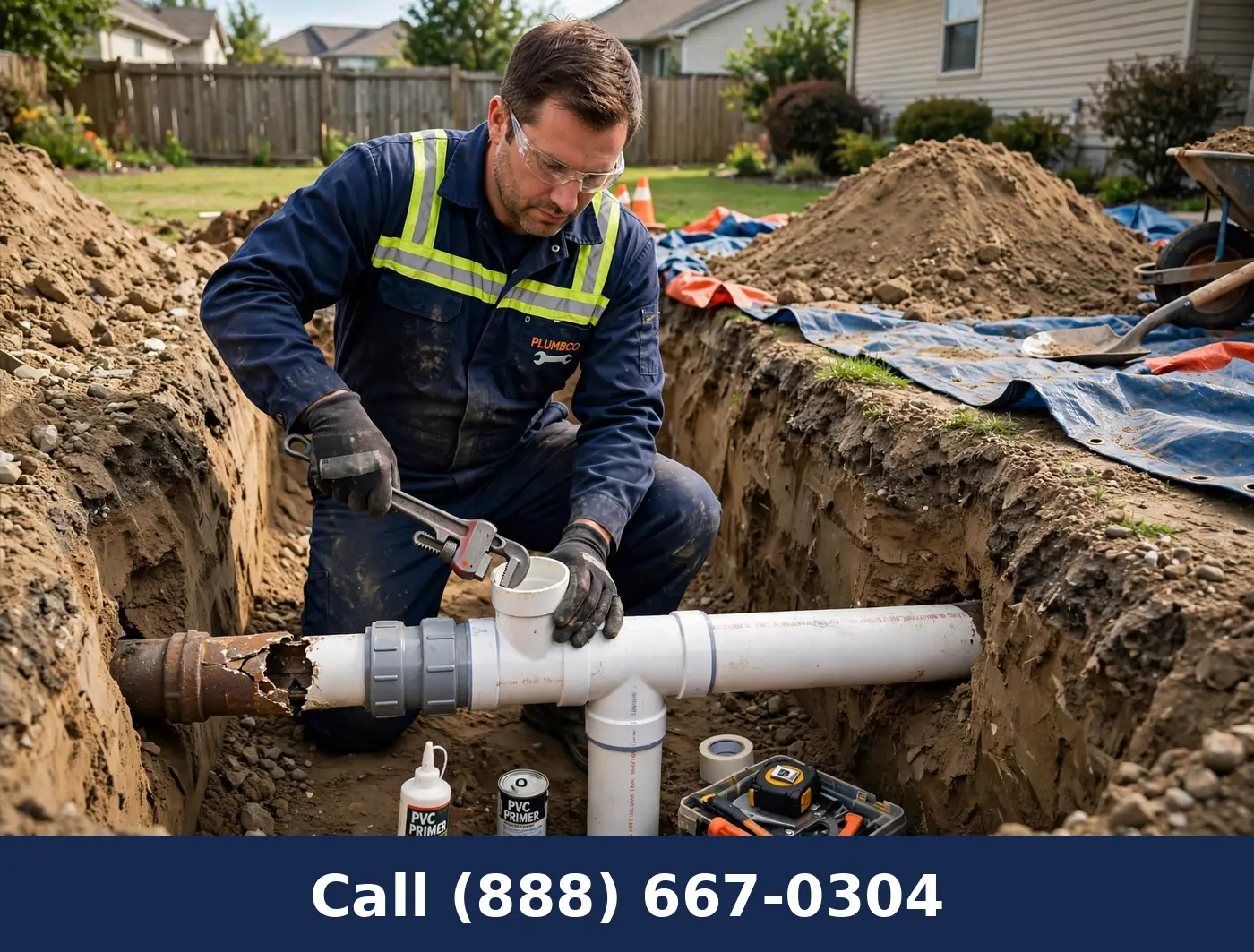
The process starts with a camera inspection that maps the damage, measures its distance from the access point, and shows the condition of the surrounding pipe. We locate the defect above ground and mark the dig area, then verify the position of buried utilities so the excavation stays safe. The excavation opens down to the failed section with the opening kept as compact as conditions allow.
We remove the damaged pipe, inspect the trench bed, and set the new pipe on a stable, properly graded base. Joints are sealed with modern couplings that resist root entry far better than the old clay joints they replace. The trench is backfilled in compacted layers, the surface is restored as closely as possible, and a final camera pass confirms smooth flow through the repaired section.
What happens to the yard and driveway during a repair?
We plan the dig site to disturb as little surface as possible, placing spoil soil on tarps and keeping equipment on a controlled path. Sod and plantings from the dig area are set aside when they can be saved, and the excavation walls are kept vertical and shored where depth requires it. After backfilling, we grade the surface to match the surrounding contour so water drains away from the area.
Hard surfaces like concrete or asphalt that must be cut are restored with matching material, though fresh patches will look newer than weathered surroundings for a time. Most homeowners find the yard presentable within days and fully settled over the following season. We walk the site with you at the end so every detail meets your approval.
What affects the cost of a sewer line repair?
Depth is a major factor, since a shallow line near the surface takes less excavation than one buried deep under a yard. Access matters too: an open lawn digs faster than a line running beneath a driveway, patio, or established garden. Soil conditions change the effort, with dense or rocky ground requiring more time than soft loam.
The length of the failed section determines how much pipe is replaced, and the number of joints or fittings involved adds labor. If the line runs under a slab or near other utilities, careful hand work slows the pace. Restoration needs for concrete, asphalt, or landscaping also shape the overall scope. We explain each of these factors at your property before work begins.
How does Plumber Modesto Pros help Modesto homeowners with sewer repair?
Plumber Modesto Pros repairs sewer lines across Modesto and nearby Central Valley communities, where clay laterals and mature trees make localized failures common. Our technicians diagnose first and dig second, so you never pay for excavation that the camera cannot justify. We size every repair to the actual defect, which keeps the work contained and the yard intact.
When you call (888) 667-0304, we start with questions about your symptoms and schedule a camera inspection at a time that suits you. From diagnosis through backfill, one team handles your job so nothing is lost between steps. The result is a repaired line you can stop thinking about.
Features
- Camera diagnosis that confirms the exact location and extent of damage
- Excavation limited to the damaged section of the lateral
- Removal and replacement of cracked, offset, or root-damaged pipe
- New sealed pipe segments that resist future root entry
- Proper re-bedding and grading so wastewater flows downhill
- Backfill placed in compacted layers to prevent settling
- Final camera pass to confirm clean flow through the repair
Benefits
- Fix only the damaged section instead of replacing the whole line
- Restore proper slope and flow through the repaired area
- Stop recurring clogs at the exact spot that keeps causing them
- Protect your foundation and soil from leaking sewage
- Keep repair work contained to one dig site
- Use modern sealed pipe materials at the repair point
- Return your drains to reliable daily use
Frequently asked questions
What is the difference between sewer repair and sewer replacement?
A repair addresses one isolated problem area, while replacement rebuilds the full run. If the rest of your pipe is sound, a targeted repair is the sensible choice.
How long does a typical sewer line repair take?
It depends on access and soil conditions. Many single-spot repairs finish in a day, while deeper or harder-to-reach sections take longer.
Can you fix just one bad section of pipe?
Yes, that is exactly what spot repair is designed for. If the camera shows one bad section in an otherwise healthy line, we dig at that one location only.
How do you avoid hitting underground utilities?
We check before digging begins so buried electrical, gas, and communication lines are identified and protected. The dig site stays marked and controlled throughout the work.
Does a severe pipe belly require digging?
Yes, when the camera shows the pipe has lost its shape or the belly is deep. Lining cannot correct a sag, so excavation is the proper fix for a severe belly.