Gas Appliance Hookup Near Me
Starting price: Call for pricing
A new gas range, dryer, or grill needs more than a push into place. Plumber Modesto Pros connects gas appliances with a new flexible stainless steel connector, a properly placed manual shutoff valve, and leak testing at every joint. Gas type, pressure, and BTU sizing are verified against the appliance rating plate so the burner gets exactly the fuel it was designed for.
What does a gas appliance hookup include?
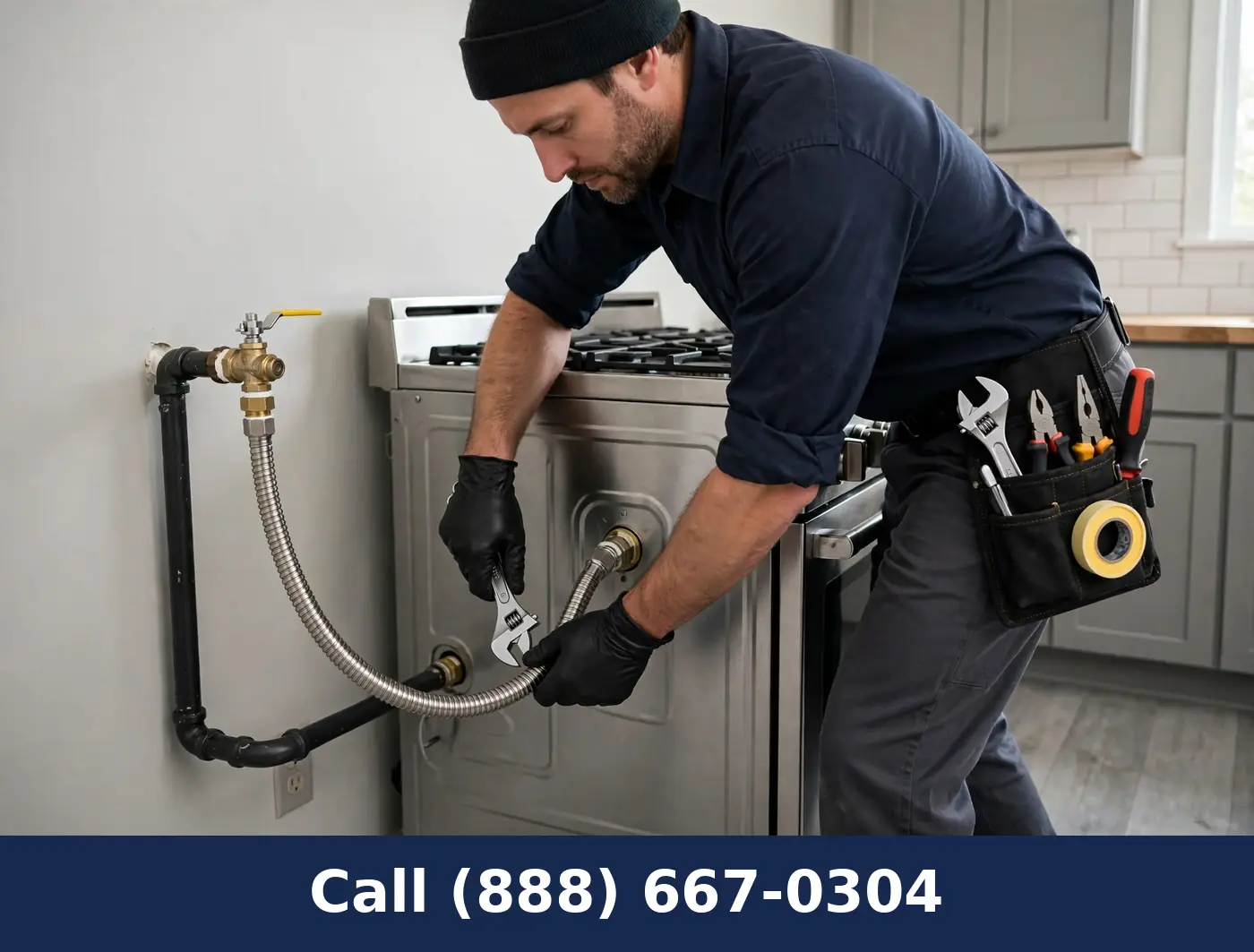
A gas appliance hookup connects a range, dryer, water heater, or grill to an existing gas stub-out. The work has four parts. A manual shutoff valve goes where it can be reached. A flexible connector runs from the valve to the appliance. The gas type and pressure are verified against the appliance's needs, and every joint is leak-tested once gas flows. It sounds simple, and it is simple when each part is done right. Skipping any one of them is how hookups become hazards. Plumber Modesto Pros completes all four and proves the appliance burns correctly before leaving.
Why must the flexible connector be new?
Flexible gas connectors are single-use parts. The corrugated stainless steel and its end fittings are designed to be installed once, and the metal fatigues when it is bent, unbent, and rebent. Reusing a connector from the old appliance risks cracks in the corrugation and worn sealing surfaces. Connectors also have a service life, and an old one may already be near the end of it. Every professional hookup starts with a new connector still in its packaging, sized for the appliance. It is one of the cheapest parts of the job and one of the most important. Plumber Modesto Pros never reuses a gas connector.
• Flexible connectors are single-use and fatigue when rebent. • A new connector is cheap protection against a cracked fitting. • The connector must be sized to the appliance's BTU demand.
How is the connector sized to the appliance?
Connector sizing follows the appliance's BTU rating and the connector's length. A gas dryer drawing around 22,000 BTU per hour can run on a smaller-bore connector than a pro-style range demanding several times that. Longer connectors carry less gas than shorter ones of the same bore, so length is part of the calculation. Sizing charts from the connector manufacturer and the National Fuel Gas Code give the capacity at each combination. An undersized connector starves the appliance: burners run weak, ovens heat slowly, dryers take too long. The rating plate on the appliance states its BTU demand and its gas type. The hookup is built from those numbers, not from whatever connector happens to be on the truck.
Where does the shutoff valve go?
Code requires a manual shutoff valve for each gas appliance, and its placement matters. It goes in the same room as the appliance, external to it, where it can be reached and operated without moving the appliance. For a range, that usually means in the cabinet beside it or in the wall behind, accessible through a panel. For a dryer, it sits on the supply stub where a hand can reach it. The valve must be the right type for gas service with a clear on-off indication. Quarter-turn ball valves are the standard because their handle position shows the state at a glance. In an emergency, or for routine service like pulling the range out to clean behind it, that valve is what makes the gas stop. A hookup without an accessible shutoff is an incomplete hookup, and it will fail an inspection.
What about gas type and pressure?
Appliances are built for a specific gas: natural gas or propane, and the two are not interchangeable without a conversion kit. The rating plate on the appliance states which one it expects, and the hookup starts by confirming the home's supply matches. Natural gas typically arrives at around 7 inches of water column, while propane runs higher, near 10 to 11. Connecting a natural-gas appliance to propane pressure, or the reverse, produces dangerous combustion. If a conversion is needed, it is done with the manufacturer's kit and the rating plate is updated. The kit changes the burner orifices and adjusts the regulator to the new fuel. Pressure at the appliance is verified so the regulator and burner orifices see what they were designed for. Skipping this verification is how mismatched appliances end up sooting or burning inefficiently.
What checks happen after the connection?
With gas restored, every new joint gets brushed with leak detection solution and watched for bubbles. Then the appliance is fired. Burner flames should burn blue and steady, with sharp inner cones. Yellow, lazy, or lifting flames mean something is wrong with the gas-air mixture or the supply, and the cause is found before the job is called done. Ovens are brought up to temperature and their cycling observed. Dryer drums turn with heat confirmed at the vent. Pilots on standing-pilot appliances are lit and adjusted. On ranges, each burner is tested individually so a weak burner on one side does not go unnoticed. These observations take a few minutes and confirm the appliance is burning its fuel cleanly and completely.
What affects the cost of a gas appliance hookup?
A straightforward hookup to an existing stub-out with a reachable shutoff location is a compact job. Adding a new shutoff valve where none exists, or relocating one to an accessible spot, adds work. Converting an appliance between natural gas and propane with a manufacturer kit is a separate task. If the existing stub-out is the wrong size for the appliance's BTU demand, the branch line may need upsizing first. Multiple appliances hooked up in one visit share the trip. For an exact figure, call (888) 667-0304 and describe the appliance and the current connection.
Why have Plumber Modesto Pros hook up your gas appliance?
The final connection is where the gas system meets the appliance, and it has to be right: new connector, reachable shutoff, correct sizing, matching gas type, and verified flames. Plumber Modesto Pros builds every hookup to that standard and tests it under working pressure before leaving. Your range, dryer, or grill gets the fuel it was designed for, with a shutoff you can reach and joints that have been proven tight. The appliance is left ready to use, with nothing left to guess about. Call (888) 667-0304 to schedule your gas appliance hookup today. It is a small job that protects a very expensive appliance.
Features
- New flexible stainless steel connector on every hookup
- Manual shutoff valve within reach in the same room
- Connector sized to the appliance's BTU rating
- Gas type verified against the appliance rating plate
- Sediment trap installed ahead of the appliance connection
- Leak detection solution testing on all new joints
- Burner flame observation and pilot adjustment after hookup
Benefits
- Your new range or dryer connected safely on day one
- A brand-new flexible connector, never a reused one
- A shutoff valve you can reach without moving the appliance
- The right connector size for the appliance's BTU demand
- Gas type and pressure verified before connection
- Every joint bubble-tested under working pressure
- Burners checked for steady blue flames before we leave