
Faucet Repair Near Me
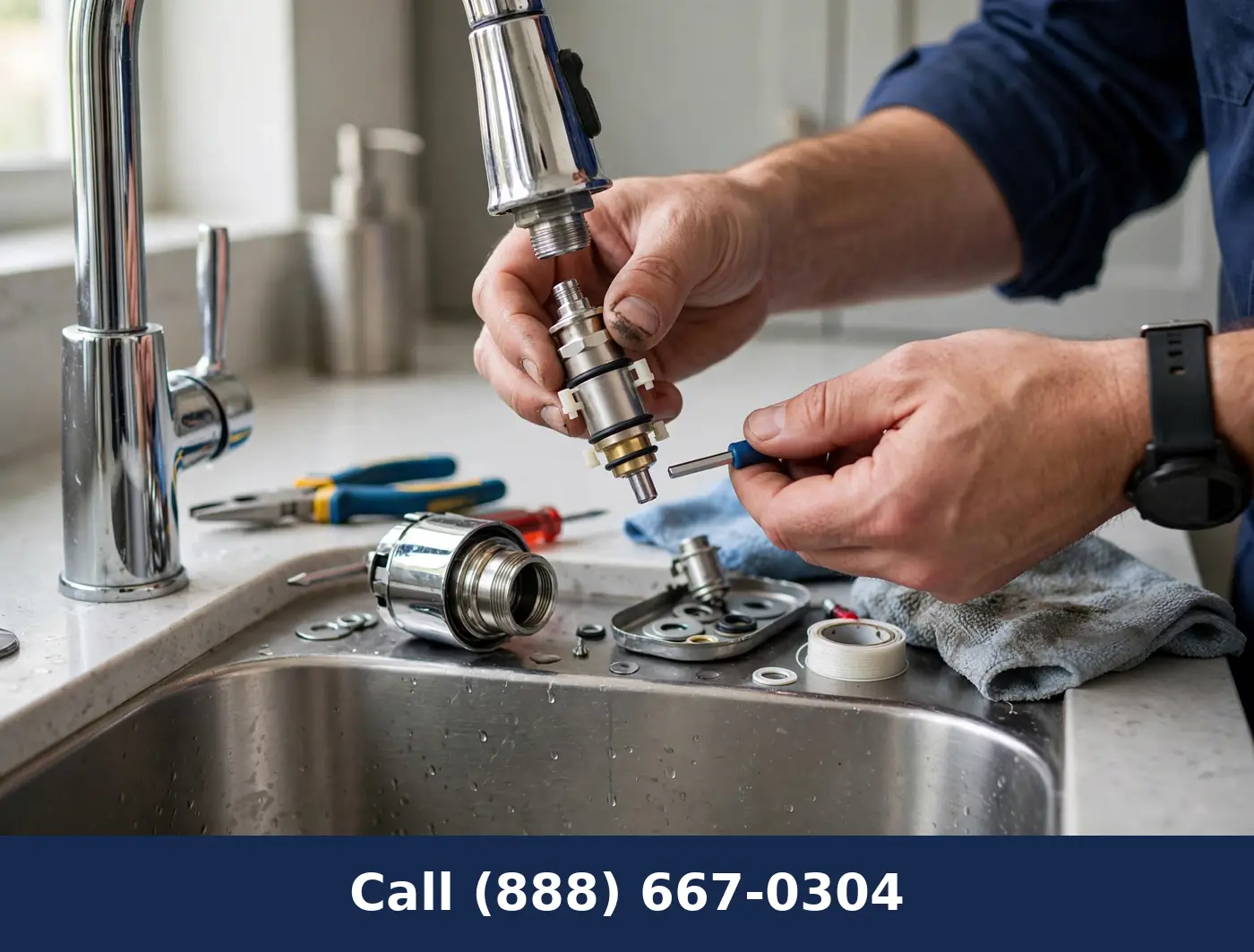
Starting price: Call for pricing
A dripping faucet wastes water around the clock and the sound wears on everyone in the house. Plumber Modesto Pros repairs kitchen and bathroom faucets by identifying the faucet type and replacing the worn seals, cartridges, or seats causing the drip. Call (888) 667-0304 to silence that drip for good.
Why does my faucet keep dripping after I turn it off?
A drip means water is getting past a seal that should be watertight, and the seal that fails depends on the faucet design. Most modern faucets are washerless: single-handle cartridge faucets use a cartridge with internal seals, ball faucets use springs and rubber seats under a rotating ball. And ceramic disc faucets use two polished discs that slide against each other. When any of these sealing surfaces wear, scratch, or collect mineral deposits, water finds a path through and the faucet drips.
Older two-handle compression faucets work differently: turning the handle drives a stem down so a rubber washer presses against a brass seat. The washer is a wear item and the seat can pit or corrode, so these faucets drip when the washer wears thin or the seat gets rough. The repair for each type is different, which is why the first step is always identifying what kind of faucet you have. Plumber Modesto Pros diagnoses by faucet type, not by guessing, so the right parts go in the first time.
What wears out inside a single-handle faucet?
Single-handle faucets mix hot and cold through one moving part, and that part takes all the wear. In cartridge faucets, the cartridge contains the seals and the mixing mechanism; years of sliding back and forth wear the seals and score the surfaces until water slips past. In ball faucets, the small springs and rubber seats that press against the ball flatten and harden. And the O-rings around the body dry out and crack, which causes leaks around the handle or the base of the spout.
Replacement is usually the whole cartridge or a complete spring-and-seat kit rather than a single tiny seal. Cartridges are keyed to fit one way, and installing the new one in the correct orientation matters. Put it in backwards and the hot and cold can reverse or the faucet can leak. Brand and model identification helps enormously here, because cartridges are not interchangeable between manufacturers. Taking the old part along to match it, or reading the model number off the faucet, avoids the wrong-part round trip.
Why do two-handle faucets drip differently?
Two-handle faucets have separate hot and cold stems, and the drip usually comes from one side. If the drip is warm, the hot side washer is the culprit; cold drip points to the cold side. The fix starts with removing the handle, unscrewing the packing nut, and backing out the stem assembly to reach the washer at its base. The washer is held by a small brass screw, and replacing it with an exact match in shape and size is essential.
The part many do-it-yourself repairs miss is the valve seat. The brass seat the washer presses against can become pitted from years of water flow and mineral content. And a new washer pressed against a rough seat will start dripping again within weeks. A seat wrench removes the old seat so it can be resurfaced or replaced. Checking the seat is the difference between a repair that lasts and one that does not.
Can hard water damage a faucet?
Hard water is one of the most common reasons faucets fail early. Mineral scale builds up on the aerator screen first, which shows up as weak, uneven, or sideways spray. Then it works into the cartridge or the sealing surfaces, scratching them and preventing a full seal. In ceramic disc faucets, scale between the two discs is often the entire problem, and a careful cleaning in white vinegar can restore the seal without any new parts.
Homes on well water see iron staining and hardness that attack fixtures from the outside in, while treated city water brings its own mineral load. The pattern of failure tells the story: aerator trouble first, then stiffness in the handle, then the drip. Regular aerator cleaning and wiping down the faucet slow the buildup, but once the internal seals are scored, replacement parts are the answer.
How do we decide between repair and replacement?
The decision comes down to age, brand, parts availability, and the condition of everything around the faucet. A faucet from a major manufacturer that is only a few years old almost always deserves a cartridge or seal kit. The parts are available and the fixture has years of life left. A twenty-year-old builder-grade faucet with corroded shutoff valves underneath is a different story, because the parts may be discontinued and the shutoffs have to be replaced anyway.
Cost of the repair relative to a new faucet matters too. If the repair needs a specialty cartridge that costs nearly as much as a mid-range new faucet, replacement is the better value. The finish condition counts as well: a faucet with pitted chrome or a flaking finish will never look new again no matter what goes on inside. Call (888) 667-0304 and get a straight answer about whether your faucet is worth repairing.What about leaks under the sink?
Not every faucet problem shows up at the spout. Water pooling in the cabinet under the sink can come from the faucet's supply connections, the shutoff valves, or the drain assembly. Finding the true source takes a dry cabinet and a careful eye. Supply-line connections weep when their washers harden or when a line has been disturbed. And shutoff valves develop slow drips around their packing nuts as the packing dries out with age. Sometimes the faucet itself is the source of an under-sink leak.
On pull-down models, the sprayer hose passes through the faucet body. And a worn hose or a loose connection at the spray head can send water down into the cabinet with every use. Leaks at the base of the spout travel down the mounting shank the same way. These are found by running the faucet and watching from below with a flashlight, which readily separates a faucet leak from a drain leak. Drain-side leaks have their own signatures.
A P-trap slip nut that has loosened, a tailpiece washer that has flattened, or a disposal connection that was never quite tight will all drip into the cabinet. The repair depends on the cause: tightening and realigning a slip joint, replacing a washer, or reseating a connection. Whatever the source, under-sink leaks deserve attention because standing water damages cabinets and invites mold long before anyone notices the floor is wet.
Features
- Cartridge replacement for single-handle kitchen and bath faucets
- Seat washer, O-ring, and stem packing replacement for two-handle faucets
- Ball faucet spring, seat, and seal repair kits
- Ceramic disc cartridge cleaning and replacement
- Spout base and handle leak repair
- Aerator cleaning and replacement for weak or uneven flow
- Brand-matched parts for major faucet manufacturers
Benefits
- Drips stopped at the source, not just quieted
- Water waste from constant dripping eliminated
- Original faucet kept when it is worth keeping
- Correct parts matched to your exact model
- Handles that turn smoothly again
- Even, full flow restored at the spout
- Honest advice when replacement is the smarter call
Frequently asked questions
Why does my faucet drip from the base of the spout?
Water at the spout base usually means the O-rings sealing the spout to the faucet body have worn out. The spout lifts off after the handle and retaining hardware are removed, and new O-rings with a light coat of plumber's grease fix it.
Why is water pressure low on only one side?
When only the hot or only the cold side runs weak, the blockage is usually in that side's supply. Common culprits are a clogged aerator, a kinked supply line, or debris in the cartridge inlet. Checking the aerator first rules out the simplest cause.
My faucet only drips at night. Why?
Municipal water pressure often rises overnight when neighborhood demand drops, and higher pressure pushes water past a marginal seal. A faucet that drips only at night has a worn seal that can no longer hold against peak pressure.
Are repair parts still available for my old faucet?
Parts for major brands are often available for decades, while off-brand and builder-grade faucets can become unavailable before long. Identifying the brand and model is the first step; if parts are discontinued, replacement is the practical path.
Should both sides be repaired on a two-handle faucet?
If one side has worn out, the other side has seen the same years of use and water. Replacing washers, seats, and O-rings on both sides during one service call prevents a repeat visit a few months later.