Drain Line Repair Near Me
Starting price: Call for pricing
Clearing a clog does no good when the drain pipe itself is cracked, bellied, or separated at a joint. Plumber Modesto Pros inspects the line with a camera first, shows you exactly what failed, and repairs the damaged section with durable replacement pipe. The result is a drain line that carries water away reliably instead of leaking it into your crawl space.
What is drain line repair, and how is it different from drain cleaning?
Drain cleaning removes blockages from inside a pipe. Drain line repair fixes the pipe itself when it is cracked, sagging, separated at a joint, or collapsed. These are different problems with different solutions, and confusing them is why some homeowners pay for cleaning after cleaning while the real issue sits untouched. A camera inspection is what tells the two apart: it shows whether the line is intact but dirty, or broken and in need of repair. When the pipe has failed, no amount of cabling or jetting will make it whole again.
How do interior drain lines fail?
Drain lines live a hard life underground and inside walls. Cast-iron lines corrode from the inside as decades of wastewater wear the metal thin, until cracks and holes appear. Clay tile lines separate at their joints as soil shifts, and each gap becomes a doorway for tree roots. Any buried line can develop a belly — a sagging low spot where the supporting soil has settled — and waste pools there instead of flowing through. Construction damage, ground movement after wet seasons, and simple age all contribute. The failure usually announces itself as a drain that clogs again and again in the same place.
What are the signs your drain line is damaged?
- The same drain backing up repeatedly after professional cleaning
- Multiple fixtures draining slowly or gurgling at the same time
- Sewage odors inside the home or in the yard with no clear source
- Lush, sunken, or soggy patches in the yard above the line route
- Water backing up in a shower or tub when a toilet is flushed
- A camera inspection that shows cracks, bellies, or root masses
- Foundation or slab moisture with no visible plumbing leak
One slow drain is usually a local clog. A pattern across fixtures, or a problem that returns on schedule after every cleaning, points to the line itself.
How does the repair process work?
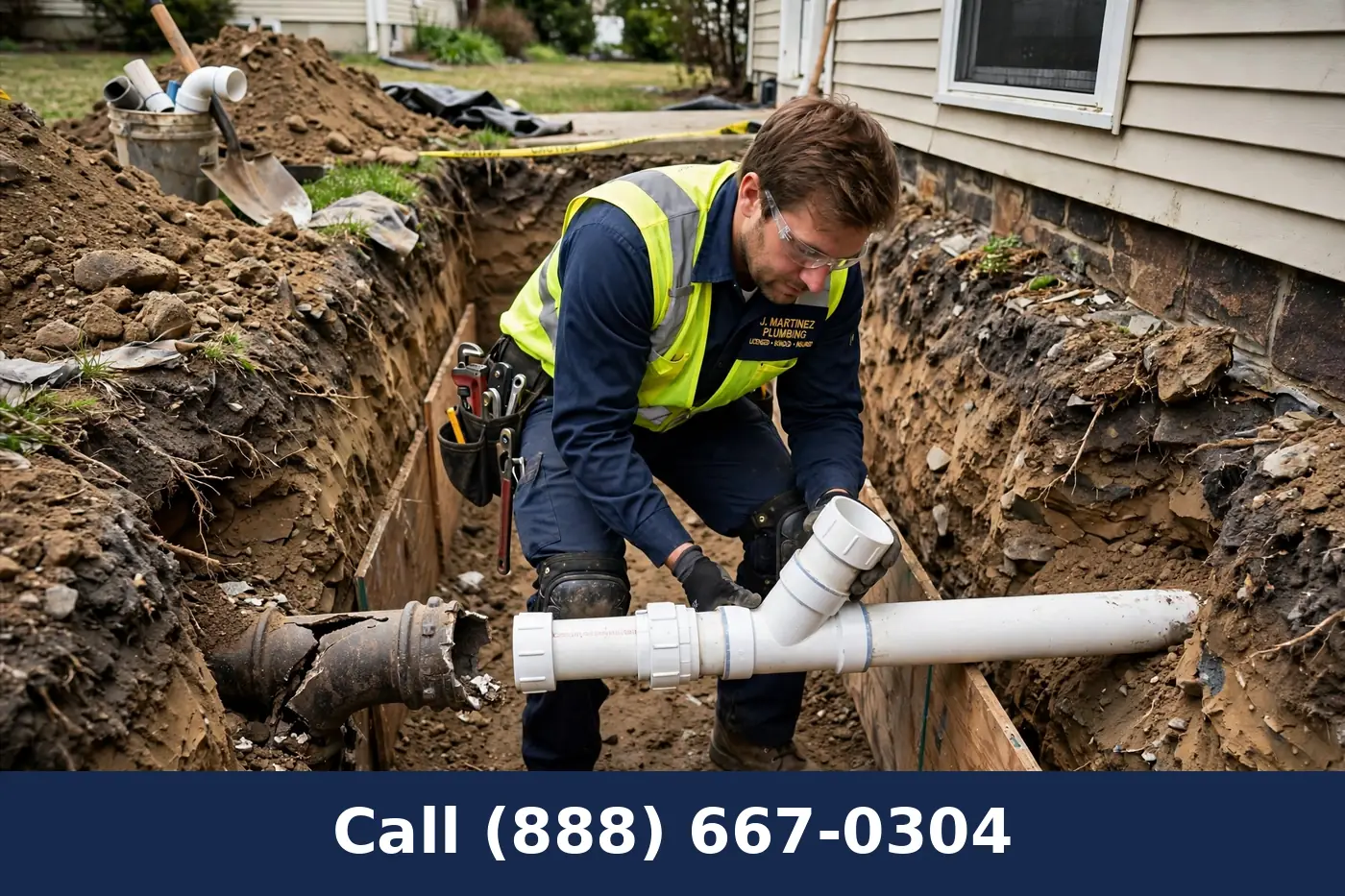
Everything starts with the camera. We feed a camera through the line and record the exact location and nature of the failure. That might be a crack at twelve feet, a belly at twenty, or a separated joint at the property line. You watch the footage with us, so the diagnosis is visible rather than verbal. Then the damaged section is exposed through a focused excavation, or through interior access where the line runs under the house. The failed pipe comes out and new pipe goes in with proper slope, because a drain line only works when gravity can do its job. Joints are sealed against root intrusion, the line is flow-tested, and the excavation is backfilled and restored.
Why does proper slope matter so much in a drain repair?
Drain lines have no pump; they rely entirely on gravity. The pipe must fall at a steady grade so water carries solids along without leaving them behind. Too flat and waste settles out, creating chronic clogs. Too steep and water outruns the solids, leaving them stranded. A belly — even a shallow one — breaks the grade and becomes a permanent collection point. When we replace a section, we bed the new pipe to restore a consistent slope through the repair. This is the detail that separates a repair that lasts from one that clogs again in a year.
Should you repair the section or replace more of the line?
The camera footage drives this decision. A single cracked section in an otherwise sound line is a clean section repair. But if the camera shows widespread corrosion, multiple bellies, or joint after joint invaded by roots, the line is failing as a system. In that case a longer replacement is the honest recommendation. Age matters: a fifty-year-old cast-iron line with one visible crack usually has more coming. We show you the full footage and explain what it means, so the scope of the repair matches the condition of the pipe.
What affects the cost of a drain line repair?
Depth and location lead the list — a shallow line in soft soil is simpler to reach than a deep line under a driveway. The length of pipe being replaced and the material it requires shape the materials portion. Access conditions, like mature landscaping or structures above the line, add care and time. If interior access under the house is needed instead of a yard excavation, the approach changes. Call (888) 667-0304 after a camera inspection and we will quote the repair against what the footage actually shows.
What happens if a broken drain line is ignored?
A cracked or separated drain line does not stay a small problem. Wastewater leaking into the surrounding soil erodes the bedding that supports the pipe, and the unsupported section sags further or collapses outright. Roots find every opening and grow into dense masses that block flow completely. Indoors, the symptoms escalate from slow drains to sewage backing up into tubs and floor drains. The repair that would have been a single section becomes a longer replacement, plus the cleanup of whatever the backup damaged. A camera inspection at the first pattern of repeat clogs is the cheapest intervention available.
How do tree roots get into drain lines?
Roots do not break into sound pipe; they exploit openings that already exist. A separated clay tile joint, a cracked cast-iron hub, or a loose PVC coupling releases a tiny amount of moisture into the soil, and nearby roots grow toward it. Once inside, the root mass thrives on the constant nutrient supply and expands the opening further. Cutting the roots clears the symptom, but the opening remains and the roots return. Lasting repair means fixing the joint or section that let them in, which is why the camera inspection matters as much as the cutting.
How does Plumber Modesto Pros repair drain lines across the Modesto area?
Plumber Modesto Pros repairs drain lines for homes across Modesto and the surrounding Central Valley. We work on the full mix of local pipe: aging cast iron, clay tile with root-invaded joints, and newer PVC. Our camera equipment rides on every diagnostic visit. Excavations stay focused on the failed section, slope is restored by measurement rather than guess, and every repair is flow-tested before we backfill. When your drain line is broken, we fix the line.
Features
- Camera inspection that shows the exact pipe failure
- Targeted repair of cracked, bellied, or separated sections
- Durable replacement pipe matched to your system
- Proper slope restored so the line drains by gravity
- Joint sealing that stands up to root pressure
- Flow testing after repair to prove the line works
- Excavation limited to the damaged section only
Benefits
- Fix the pipe, not just the clog, for a lasting result
- Stop wastewater from leaking into soil or crawl spaces
- End the repeat clogs caused by a broken section
- Restore proper drainage slope that gravity needs
- Keep roots from re-entering through failed joints
- Protect your foundation from undermining water
- Get a repair backed by a camera-verified inspection
Frequently asked questions
How do I know my drain line needs repair, not just cleaning?
When the same line clogs again soon after a thorough cleaning, or a camera shows a crack, belly, separation, or collapse, the pipe itself is the problem. Cleaning a broken pipe is like mopping around a leaking bucket — the fix has to address the pipe.
What is a belly in a drain line?
A belly is a low spot where the pipe has sagged, allowing water and solids to pool instead of flowing through. Waste collects in the sag and causes chronic clogs. The section must be re-graded or replaced to restore proper slope.
Will you have to dig up my yard to repair a drain line?
Only the damaged section is excavated. The camera inspection tells us exactly where the failure is, so the digging stays focused instead of opening the whole line route.
What pipe materials do you use for drain repairs?
We match the repair to your system, typically using PVC or ABS for replacement sections. The new pipe is joined to the existing line with proper fittings and sealed against root intrusion at every joint.