
Commercial Kitchen Plumbing Near Me
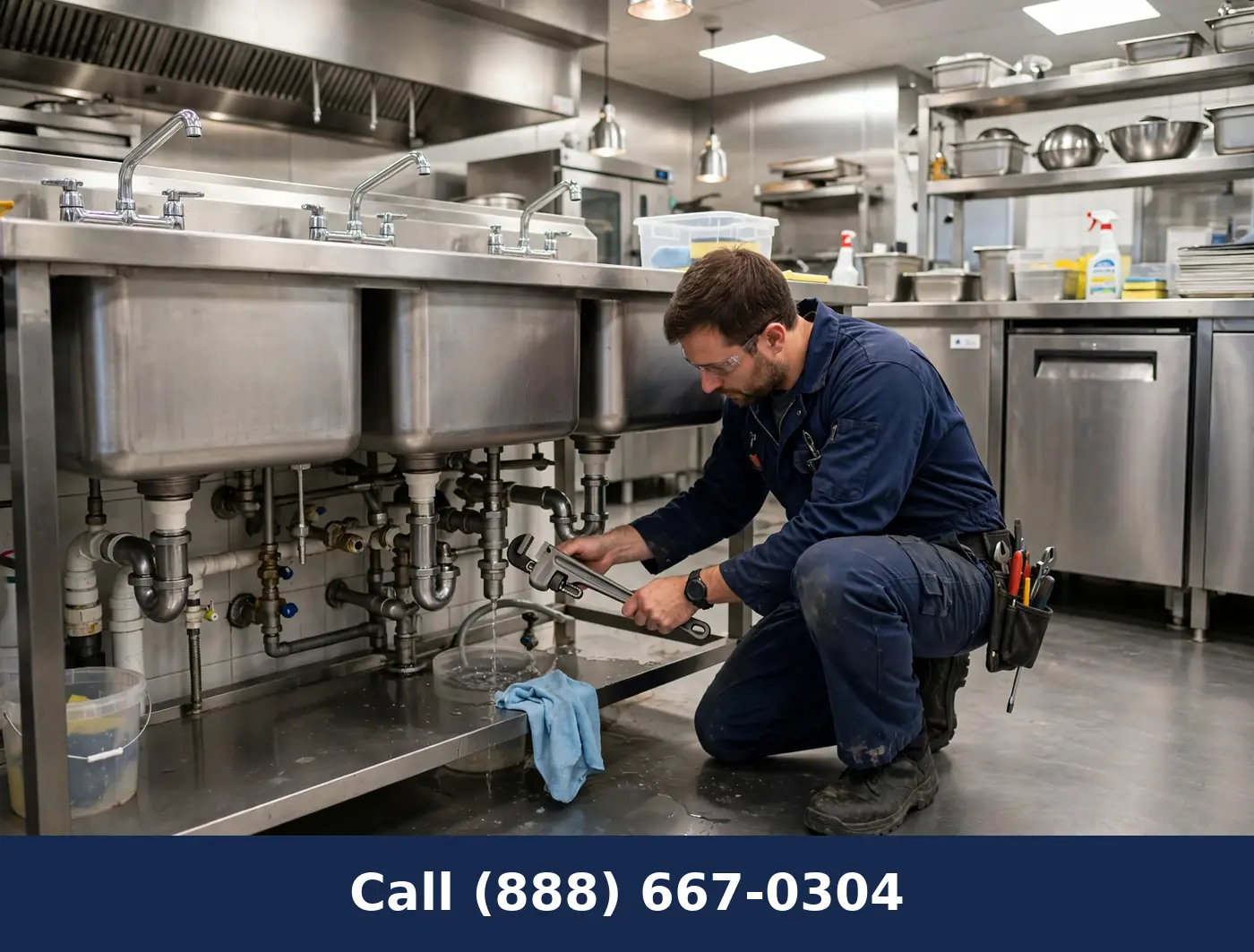
Starting price: Call for pricing
Commercial kitchen plumbing covers the grease interceptors, high-volume drains, fixtures, and water lines that keep a restaurant or food-service kitchen operating through every meal rush. Plumber Modesto Pros services kitchens with grease management, drain care, and fixture repair sized for commercial demand. Call (888) 667-0304 to schedule service for your kitchen.
What does commercial kitchen plumbing actually cover?
A commercial kitchen is one of the hardest-working plumbing environments there is. Water runs almost constantly, dishes pile up, grease flows toward the drains with every shift, and a single failed fixture can slow the whole line. Commercial kitchen plumbing covers everything that moves water and waste in that space, from grease interceptors and traps to floor sinks, prep sinks, dish machines, ice makers, and steamers. It also covers water lines, gas lines for cooking equipment, and backflow assemblies that protect the water supply.
It does not cover refrigeration, cooking equipment repair, or hood ventilation. The focus is the piping, fixtures, and valves that keep water coming in and waste going out.
Restaurant kitchens use far more water per day than a home, and the waste they produce is different too. Grease, fats, and food solids load the drain system in ways a residential system never sees. That is why commercial kitchen plumbing is its own discipline, with different sizing rules, different maintenance habits, and different equipment. A plumber who works in these kitchens has to think about the whole system at once, from the prep sink to the interceptor to the building sewer connection.
Why do grease interceptors matter so much?
Grease interceptors, sometimes called grease traps in their smaller indoor form, sit between the kitchen and the sewer. Their job is simple to describe and important to get right. They slow wastewater down so fats, oils, and grease float to the top while heavier solids sink, letting only the cleaner middle layer flow on toward the sewer. Without a working interceptor, grease enters the sewer line, cools, and hardens into deposits that narrow the pipe until it blocks completely. That blockage does not stay at the restaurant door; it can back waste up into the kitchen or into the municipal line.
Health departments and sewer agencies in most cities require food-service establishments to have grease interceptors sized for their flow, and they commonly ask for maintenance records during routine visits. A plumber can install a new interceptor, replace a failing one, adjust the piping around it, and repair the components that connect it to the rest of the system. Pumping itself is usually handled by a waste hauler on a recurring schedule. But the plumbing around the interceptor, from the flow-control fitting to the outlet line, is plumbing work through and through.
How do we keep high-volume drains flowing?
Kitchen drains carry grease-laden water all day, and over time a coating builds up on the inside of the pipe. Drain cleaning for commercial kitchens goes beyond a basic auger pass. Cable cleaning breaks up soft blockages and pulls back the debris. Hydro-jetting scours the pipe walls with high-pressure water to strip away the grease layer so the full diameter of the pipe is available again. Which method fits depends on the pipe material, its condition, and what is causing the restriction.
Floor sinks and floor drains deserve special attention because they are easy to overlook. Indirect drains from dish machines, prep sinks, and ice makers often discharge into floor sinks, and if those floor sinks clog, the waste has nowhere to go but the floor. Regular cleaning of these receptors keeps the small daily overflows of water from becoming a sanitation problem. Trench drains in dish-pit areas collect the same kind of loading and need the same periodic attention.
What happens when a kitchen drain backs up during service?
A backup during meal service is one of the worst things that can happen to a restaurant. The first step is always to stop the source: shut off the fixtures feeding the affected drain so the situation does not get worse. Standing water and waste on a kitchen floor is a health concern, so the area needs to be isolated while the line is cleared. Then the plumber works from the most accessible cleanout or fixture to locate the blockage, clear it, and test the flow before the area is returned to use.
Recurring backups in the same line usually point to something structural. The cause may be a sagging section of pipe that collects grease, a root intrusion near the building exit, a narrowed section from years of buildup, or an undersized interceptor. A camera inspection can show exactly what the inside of the line looks like, which is far more useful than clearing the same spot every few weeks. Plumber Modesto Pros looks for the underlying cause, not just the symptom, so the fix actually holds.
How do gas hookups and water lines fit in?
Commercial kitchens run on gas as well as water. Ranges, fryers, griddles, and ovens all need properly installed gas connections with accessible shutoff valves, and those connections have to be checked and repaired with special care. Moving a range for a deep clean, replacing a fryer, or adding a new piece of cooking equipment all involve disconnecting and reconnecting gas lines. That work has to be done right every time.
On the water side, dish machines, ice makers, steamers, and combi ovens each need dedicated supply lines with the right pressure and proper shutoffs. Many of these machines also need filtered water, and the filter assemblies and connections are part of the plumbing scope. Backflow prevention assemblies protect the building water supply from contamination when equipment pressure changes. And these devices are commonly tested and replaced on a schedule set by the local water authority.
What does a typical service visit look like?
The visit starts with a conversation about what is going wrong and when it happens. Timing details matter in a kitchen: a drain that slows only during the dinner rush behaves differently from one that is always sluggish. After that, the plumber inspects the affected fixtures, drains, and visible piping, then runs water to reproduce the problem when it is safe to do so. Diagnosis comes before repair, and the findings are explained in plain terms so the decision is clear.
Once the work is agreed on, the repair is carried out with the kitchen schedule in mind. Simple fixture repairs can often be done between rushes, while bigger jobs like interceptor replacement or line repair are scheduled during closed hours so the kitchen loses no service time. After the work is finished, everything is tested under real conditions: fixtures are run, drains are flowed, and connections are checked for leaks before the crew leaves. The goal is to hand the kitchen back ready for the next shift.
What affects the cost of commercial kitchen plumbing work?
Several factors shape what a commercial kitchen plumbing job involves. Access is a big one: equipment that has to be moved, tight crawl spaces, or lines buried under concrete all add labor. The type of pipe matters too, because cast iron, copper, and plastic each call for different tools and fittings. Interceptor size and depth affect both installation and replacement work.
Emergency or after-hours scheduling carries different considerations than planned work during closed hours. Parts availability matters as well, especially for older commercial fixtures. For an exact figure on your specific situation, call (888) 667-0304 and describe what is happening; a straightforward conversation up front leads to an accurate scope of work.
Features
- Grease interceptor and grease trap installation, service, and replacement
- High-volume drain and floor-sink cleaning for prep and dish areas
- Commercial faucet, pre-rinse sprayer, and pot-filler repair
- Gas line hookups and repairs for ranges, fryers, and ovens
- Backflow prevention assembly testing and replacement
- Floor drains, trench drains, and mop sink installation and repair
- Water line repair for dish machines, ice makers, and steamers
Benefits
- Fewer plumbing interruptions during busy meal service
- Grease systems maintained for local health-department compliance
- Drains sized and cleaned to handle peak dishwashing volume
- One point of contact for all kitchen plumbing issues
- Fixtures chosen to stand up to constant commercial use
- Service scheduled around your operating hours
- Straightforward assessments before any work begins
Frequently asked questions
How is a grease trap different from a grease interceptor?
The terms describe different sizes of the same idea. Small indoor units under sinks are usually called grease traps, while large outdoor underground tanks are called grease interceptors. High-volume kitchens typically need the larger interceptor type.
How often should our interceptor be pumped?
Most high-volume kitchens pump every one to three months, depending on how much grease the menu produces. The right interval keeps grease and solids well below the interceptor's rated capacity between visits.
What should we do if a drain backs up during dinner service?
Stop using the fixtures that feed the affected drain and isolate the area so wastewater stays off the kitchen floor. Then call (888) 667-0304 so a plumber can clear the line and check what caused it.
Can you service our kitchen without shutting it down?
Many fixture and drain repairs can be done during slow periods without stopping service. Larger work, like interceptor replacement or buried-line repair, is usually scheduled during closed hours.
What causes recurring grease-line clogs?
The usual causes are heavy grease loading, a sagging or damaged pipe section, an undersized interceptor, or a line that has narrowed from years of buildup. A camera inspection shows which one you are dealing with.